
How leaders make defensible transformation choices under finite capacity, interdependence and uncertainty
ProjPro Executive Insight Series | PP-WP-002-V1.0
Estimated reading time: 13 minutes
Overview
Every consequential transformation begins before leaders possess complete certainty. The destination may be compelling, but the route competes with existing commitments, scarce capability, operational obligations and other legitimate priorities. Decisions must still be made: what to fund, what to sequence, what to defer, what to stop and what the organisation should deliberately refuse to attempt at the same time.
This makes transformation fundamentally an executive choice problem. Individually attractive initiatives can form a collectively unexecutable portfolio. A roadmap can appear coherent while relying on the same specialists, unresolved architecture decisions, unavailable operational capacity or assumptions that have never been tested. Approval signals intent; it does not create the conditions required to deliver and absorb change.
ProjPro defines executable transformation as the condition in which strategic intent has been translated into a credible enterprise pathway supported by explicit outcomes, coherent enterprise choices, understood capability and architecture implications, realistic portfolio priorities, visible dependencies, sufficient delivery and absorption capacity, accountable decisions and evidence capable of changing the pathway when conditions change.
The executive question is therefore not simply what should change. It is: what combination of change represents the most credible use of enterprise capacity now, and what evidence would cause us to reconsider that choice?
| EXECUTIVE SNAPSHOT: The defining executive question is not simply what should change. It is why this combination of change, in this sequence, is the most credible use of enterprise capacity now. |
Ambition Competes for Finite Enterprise Capacity
Transformation portfolios rarely operate in isolation. The same organisation may simultaneously pursue growth, cost reduction, regulatory change, technology modernisation, customer improvement, artificial intelligence adoption, cyber resilience, operating-model change and workforce transformation. Each initiative may have a legitimate rationale. The difficulty emerges when those initiatives compete for the same executive attention, specialist capability, architecture capacity, operational subject-matter experts, data and integration foundations, change capacity, funding, test environments and deployment windows.
This creates an important distinction between initiative attractiveness and portfolio executability. A portfolio containing ten individually justified initiatives is not necessarily more valuable than one containing six. The relevant question is whether the combination creates a credible pathway to the intended enterprise outcomes. That requires leaders to make opportunity cost visible. Approving one intervention may delay another. Accelerating one programme may consume scarce capability needed elsewhere. Deferring enabling architecture may create an appearance of speed while increasing combined delivery risk.
Capacity is therefore not a downstream planning detail. It is part of strategy. The organisation must be able to defend not only why each initiative matters, but why this combination and sequence is the best use of finite enterprise capacity under current conditions. Portfolio guidance from Government Project Delivery, the Project Management Institute and Australian government sources similarly connects portfolio decisions with strategic objectives, constraints, resources, benefits and the organisation's ability to absorb change.
Approval Does Not Create Executability
Executive approval authorises intent, investment or mobilisation. It cannot manufacture capacity or remove unresolved dependencies. Nor does it automatically reconcile architecture choices, supplier constraints, regulatory obligations, operational risk, capability gaps or competing change demand.
This is why a transformation may appear healthy at initiative level while becoming increasingly difficult at enterprise level. Different decisions may have been made at different times using different assumptions, evidence and organisational contexts. Individually rational commitments can create a collectively implausible portfolio.
Executability therefore needs to be tested at portfolio and enterprise level. It cannot be inferred from the quality of individual business cases, the precision of a roadmap or the confidence of a sponsor. Approval should establish authority to proceed within defined conditions; it should not be treated as proof that those conditions already exist.
Five Tests of Executable Transformation
1. Outcome clarity. Can leaders explain what must become materially different in capability, customer outcome, operating performance, risk position or strategic option? Delivering a platform is not an enterprise outcome. Outcome clarity provides the basis for later trade-offs.
2. Portfolio coherence. Do the interventions collectively form a credible pathway? Leaders need visibility of enabling work, mandatory work, dependencies, shared architecture, common data foundations, resource contention and cumulative change demand. Portfolio coherence asks whether the whole makes sense.
3. Enterprise capability. What must the organisation become capable of doing differently? Transformation changes combinations of people, processes, information, applications, technology, security, integration, compliance, decision rights and operating responsibilities. These implications should be understood before irreversible commitments are made.
4. Capacity and dependency realism. Can the organisation deliver and absorb the proposed combination of change? Capacity includes the ability to decide, design, build, test, train, transition, support and operate - not only headcount.
5. Adaptive decision evidence. What evidence would cause leadership to change the pathway? The objective is not to eliminate uncertainty. It is to expose important assumptions, understand evidence confidence, assign decision ownership and define the conditions for continuing, sequencing, reshaping, pausing or stopping.
The ProjPro Executable Transformation Model
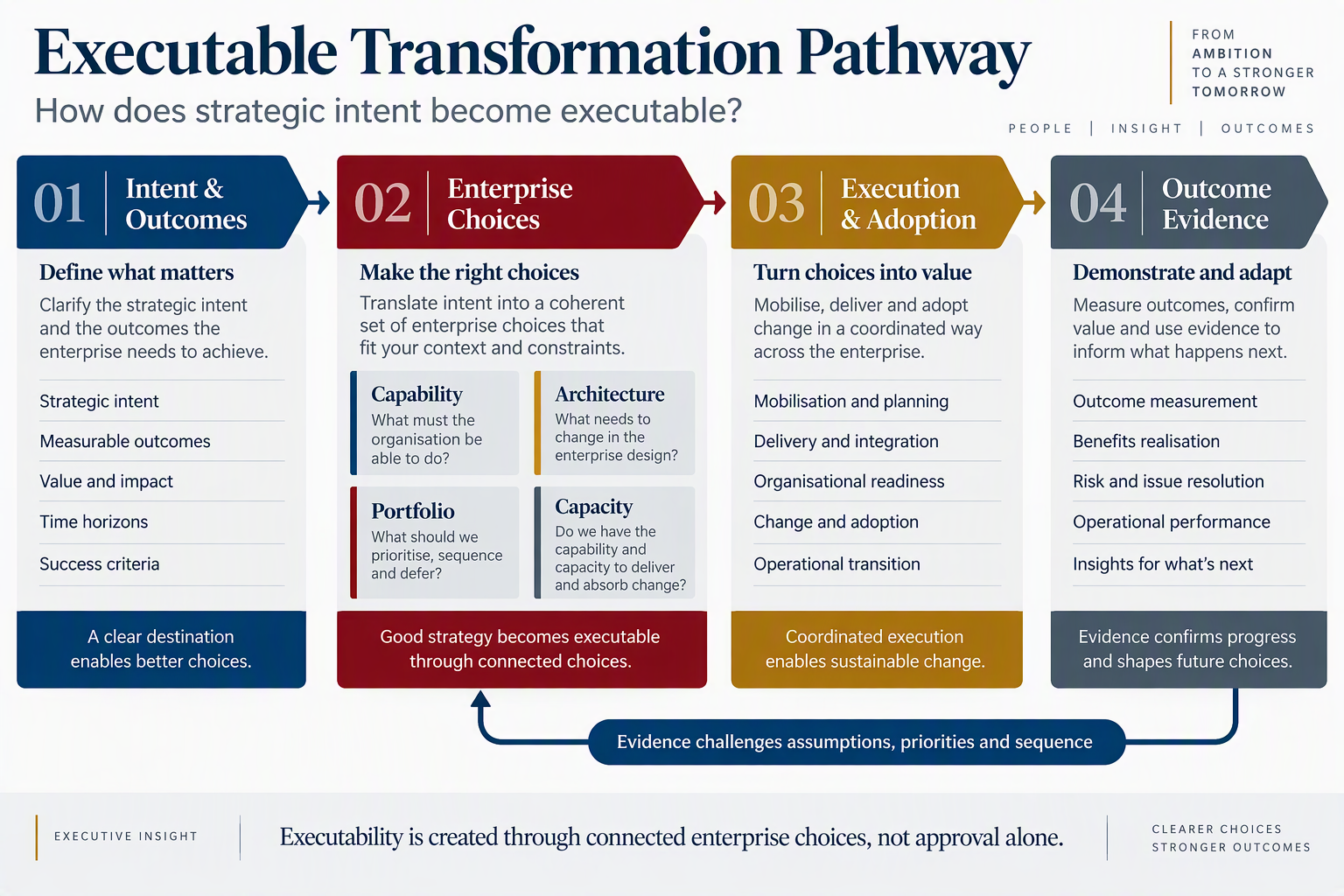
The ProjPro model connects Intent and Outcomes to Enterprise Choices, then to Execution and Adoption, and finally to Outcome Evidence. Enterprise Choices include capability, architecture, portfolio and capacity because these decisions establish whether ambition can move credibly into action.
The model is deliberately not a one-way lifecycle. Outcome evidence returns to enterprise choices. Evidence may confirm the pathway, expose a weak assumption, reveal a dependency, change the value case or show that operating adoption is insufficient. Revisiting an earlier choice is not evidence of failed strategy. It is evidence that leadership is governing transformation as a living enterprise system.
Executability is therefore continually demonstrated, not declared once. The pathway remains credible only while its assumptions, sequence and capacity remain defensible.
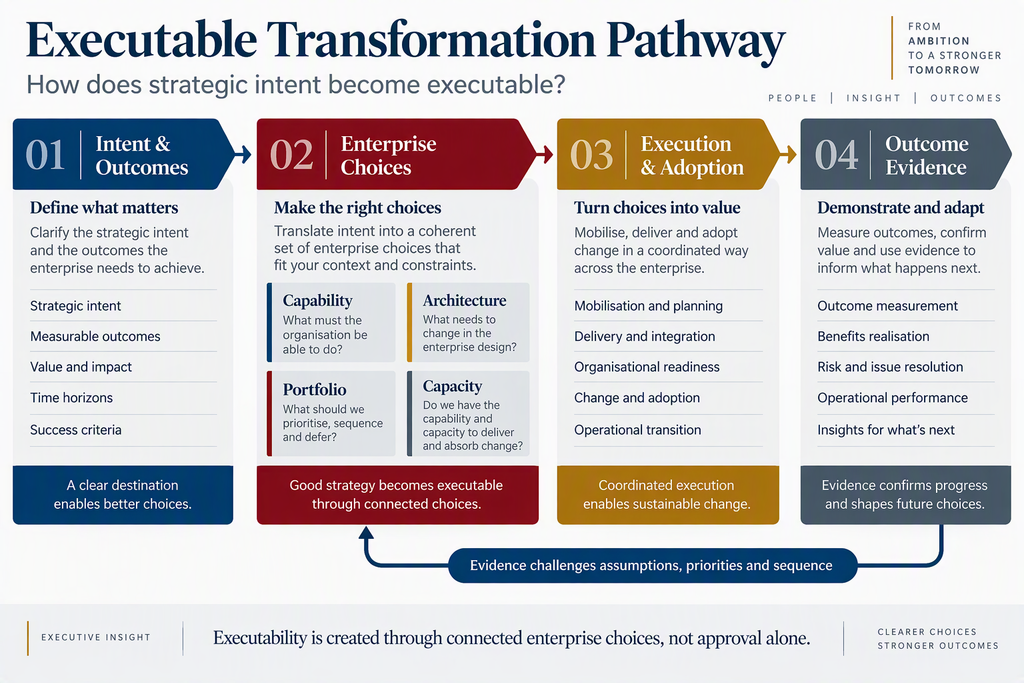
Figure 1. Executability is created through connected enterprise choices, not by approval alone. Outcome evidence returns to challenge assumptions, priorities and sequence.
Transformation Readiness as a Decision Condition
Readiness should not become another generic maturity score. The six foundational dimensions are Strategic Clarity, Executive Alignment, Business Capability, Transformation Capacity, Portfolio Alignment, and Governance and Risk. Together they describe the conditions relevant to a consequential transformation decision.
Current maturity, required maturity, evidence confidence and priority answer different questions. Current maturity describes demonstrated capability now. Required maturity describes what the contemplated transformation actually needs. Evidence confidence describes how defensible the conclusion is. Priority asks where action is justified by materiality, value, obligations, risk, urgency, dependencies and effort.
A lower maturity rating is not automatically adverse. The organisation may not require Optimised maturity in every dimension. Equally, a high rating supported only by anecdotal evidence does not create decision confidence. The assessment must preserve the difference between capability and the confidence with which that capability has been demonstrated.
ProjPro applies the universal scale: 1 Initial, 2 Developing, 3 Defined, 4 Managed, 5 Optimised and N/A Not Assessed. Not Assessed is not zero. The practice determines what is assessed; the universal model determines how maturity is classified.
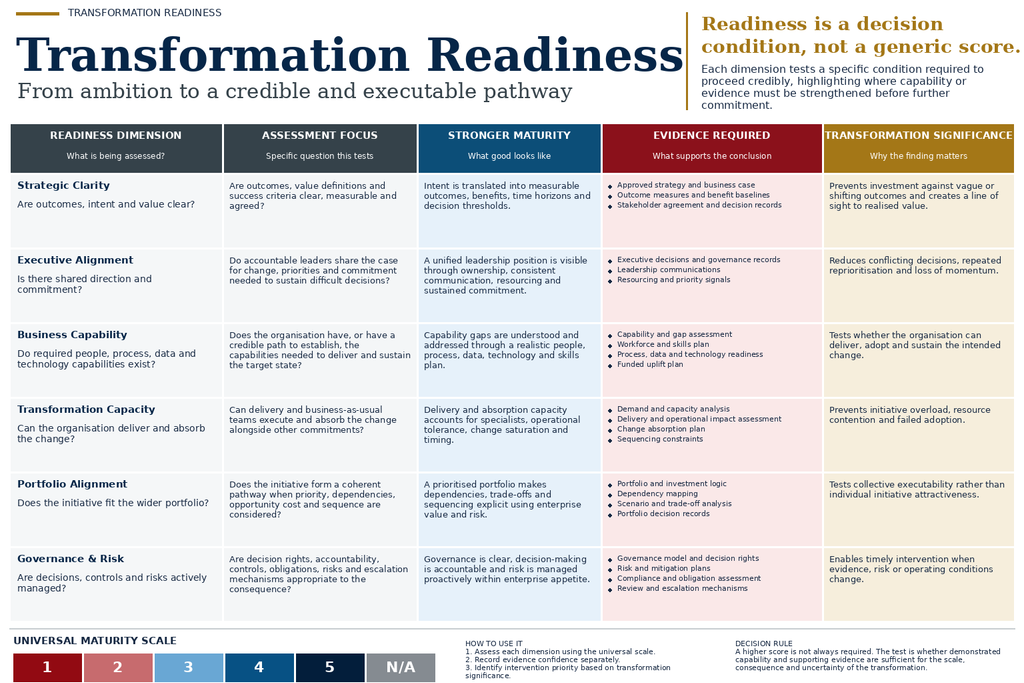
Figure 2. Transformation readiness combines six foundational decision-relevant dimensions.
Portfolio Capacity as Part of Strategy
Consider customer platform modernisation, enterprise data transformation and artificial intelligence enablement. Each may have a compelling business case. If all three depend on the same enterprise architects, data and integration specialists, operational subject-matter experts and business change capacity, their combined execution profile is materially different from their individual cases.
The strategic question becomes: what sequence creates the greatest enterprise value while protecting the capacity required to succeed? One response may establish shared data and integration foundations first, sequence customer-platform change second and scale selected artificial intelligence use cases once the information, controls and operating context are credible. The exact answer is contextual; the principle is not.
Deferral is not necessarily failure. It can be evidence of disciplined portfolio choice. Likewise, enabling work should not be disadvantaged merely because its value is distributed across other initiatives. A defensible portfolio recognises shared foundations, mandatory obligations and no-go constraints alongside visible business initiatives.
Capacity analysis should also consider the ability to absorb change. Operational teams may be able to support design workshops while being unable to absorb testing, training, cutover and stabilisation across several initiatives in the same period. A credible sequence protects both delivery throughput and operational continuity.
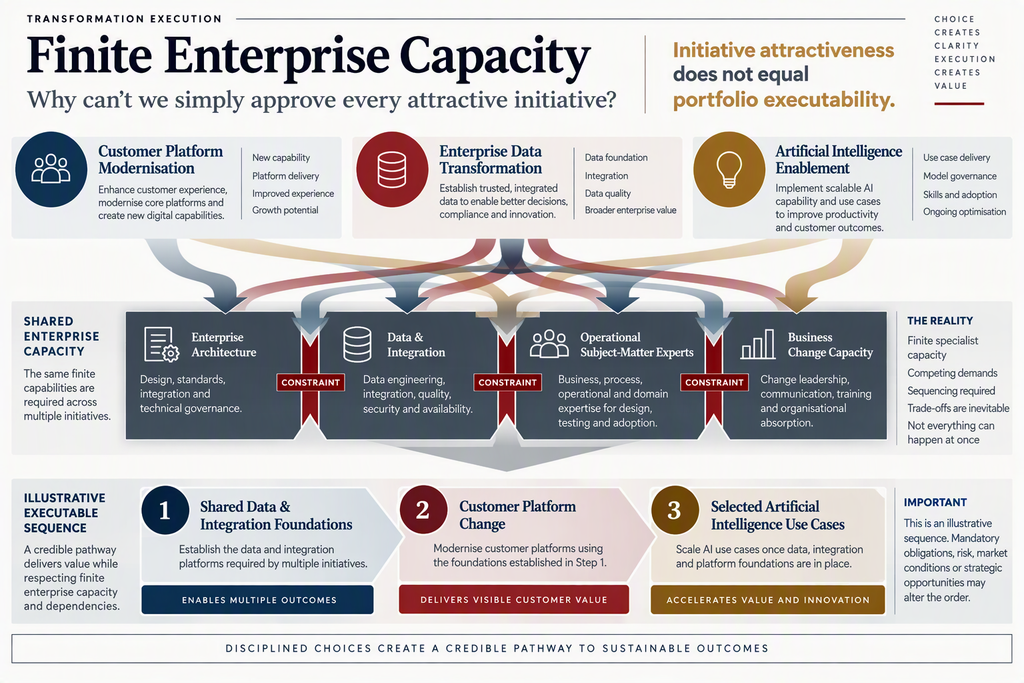
Figure 3. Three illustrative initiatives compete for shared enterprise capacity, showing why sequence determines collective executability.
Decision Evidence Under Uncertainty
Executives rarely receive perfect evidence. The objective is decision sufficiency, not artificial certainty. For consequential choices, leadership should make the decision, intended outcomes, credible options, assumptions, supporting and contradictory evidence, confidence, dependencies, capacity consequence, reversibility, authority and review trigger explicit.
This changes the quality of approval. Instead of presenting a preferred option as inevitable, leaders can distinguish fact from assumption, compare alternatives, expose trade-offs and decide how much uncertainty is acceptable. Reversibility matters because a decision that is easy to revisit can tolerate less certainty than one that locks the enterprise into a platform, supplier, operating model or regulatory posture.
A review trigger is equally important. It defines what new evidence or changed condition should cause reconsideration. Without one, organisations often continue because the programme is already underway rather than because the original rationale remains sound.
Decision evidence should be proportionate. A reversible experiment does not require the same depth as a multi-year commitment. The discipline lies in matching the evidence, authority and review mechanism to the consequence of the choice.
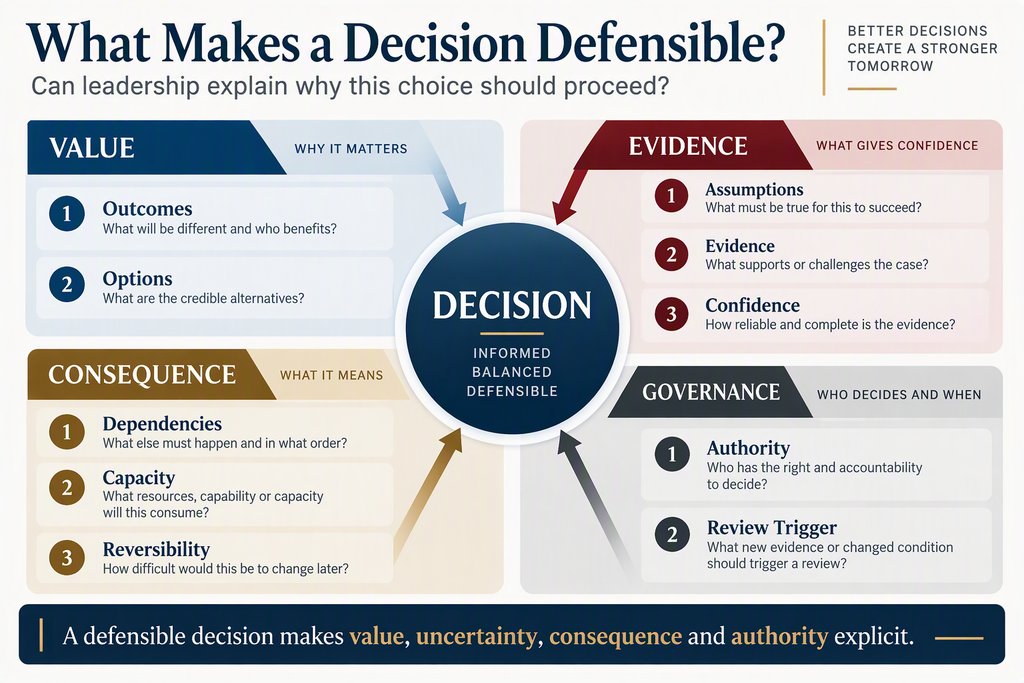
Figure 4. A consequential decision becomes more defensible when value, evidence, consequence and governance are explicit.
What Good Looks Like
Executable transformation does not require perfect certainty. It requires sufficient enterprise coherence to make consequential choices deliberately. Outcomes influence investment decisions. Portfolio trade-offs are explicit. Dependencies are visible and owned. Architecture implications are considered before irreversible commitments. Capacity assumptions are realistic. Enabling work is recognised. Assumptions are recorded and testable. Evidence confidence is visible. Decision rights match consequence. Operational adoption is considered before deployment. Benefits ownership extends beyond programme closure. Outcome evidence can change priorities.
The result is not a static transformation plan. It is a credible transformation pathway: clear enough to mobilise, disciplined enough to govern and adaptive enough to remain relevant as conditions change.
Seven Patterns That Reduce Executability
Treating approval as capacity. Funding an initiative does not create the capability required to deliver or absorb it.
Prioritising initiatives independently. Individual business cases obscure portfolio contention, shared dependencies and cumulative change demand.
Hiding enabling work. Architecture, data, integration, security and operating-model foundations may create value indirectly across several initiatives.
Sequencing by sponsor pressure. Urgency is legitimate evidence, but it should not silently override dependencies or enterprise consequence.
Confusing roadmap precision with certainty. Detailed dates can create confidence without reducing underlying uncertainty.
Protecting sunk commitments. Past investment should not prevent leaders reconsidering an intervention whose assumptions have changed materially.
Measuring activity rather than changed capability. Mobilisation, milestones and expenditure show activity; they do not independently demonstrate transformation.
Key Practices
- Define outcomes before interventions. Clarify what must become different before deciding how to change it.
- Make assumptions visible. Important transformation assumptions should be explicit enough to test.
- Model portfolio scenarios. Compare alternative combinations and sequences rather than only ranking initiatives.
- Protect constrained capacity. Identify scarce capability and allocate it deliberately.
- Govern dependencies. Dependencies require ownership, consequence and decision authority.
- Stage commitment. Where uncertainty is material, preserve options rather than committing irreversibly too early.
- Establish adaptation triggers. Define evidence that would justify continuing, sequencing, reshaping, pausing or stopping.
- Connect benefits to operational ownership. The outcome owner must remain accountable after delivery transitions into operation.
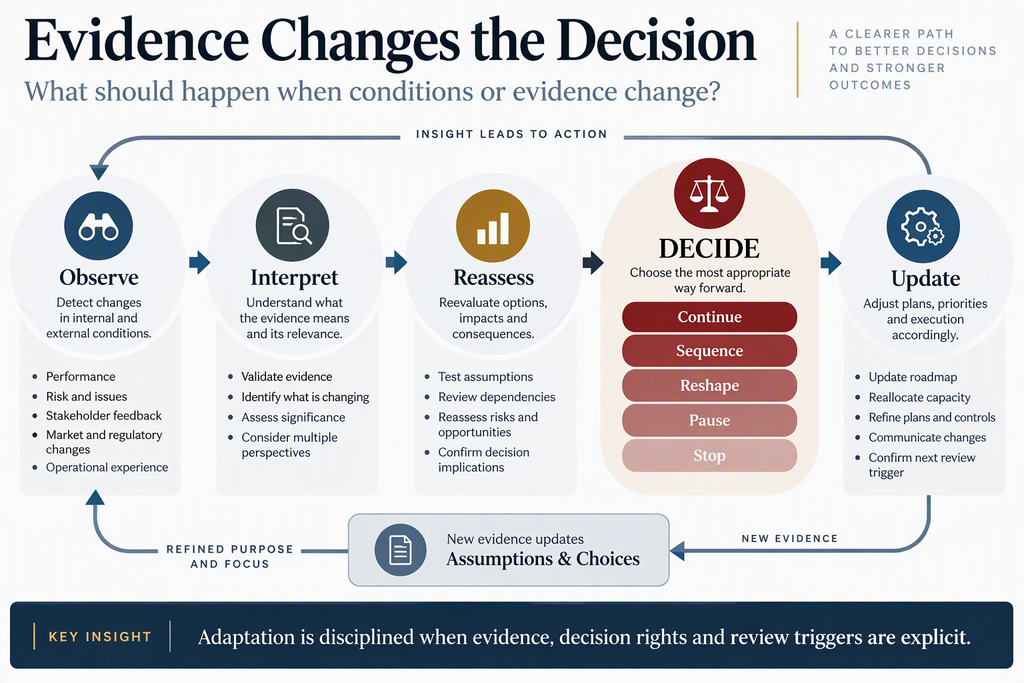
Figure 5. Evidence supports disciplined adaptation through a recurring cycle of observation, interpretation, reassessment, decision and update.
ProjPro Perspective
Transformation is often discussed as though strategy hands a fixed destination to delivery. In practice, consequential change crosses strategy, architecture, portfolio management, programme delivery, operational readiness, governance, risk and benefits realisation. Treating those disciplines as sequential hand-offs weakens the evidence available to leaders and hides the trade-offs that determine whether the pathway is credible.
ProjPro's perspective is that executability is an enterprise property. It is created when leaders can connect intent to choices, choices to capacity, capacity to sequence, sequence to controlled execution, and execution to evidence of changed capability and realised outcomes. No single artefact creates that condition. A business case, roadmap, architecture, programme plan or dashboard can contribute, but only when the relationships between them are governed.
This perspective also changes the role of challenge. Asking whether an initiative should be deferred, reshaped or stopped is not anti-transformation. It protects the portfolio from commitments that cannot be defended collectively. Equally, defending enabling architecture, data foundations, controls or operational readiness can be strategically important even when their value is less visible than a customer-facing initiative.
EAOps Alignment
Enterprise Architecture Operations (EAOps) provides the connective operating logic for keeping strategy, architecture, governance, delivery, operations and evidence aligned as change progresses. It complements established customer methods, repositories and tools rather than requiring a parallel methodology.
EAOps ensures transformation choices remain traceable after approval. Assumptions, dependencies, obligations, architecture decisions, delivery evidence, operational performance and benefits can inform later reviews. This creates continuity without implying that every transformation requires a new platform or a permanent external dependency.
Conclusion
Transformation becomes executable when leadership can defend the pathway, not merely the ambition. That means being explicit about outcomes, enterprise capability, architecture implications, priorities, constraints, dependencies, capacity, sequence, decision authority and the evidence that would justify adaptation.
The discipline is not about slowing change until uncertainty disappears. Uncertainty will remain. The objective is to commit at the right level, preserve options where appropriate, protect scarce capability and ensure new evidence can alter the route before sunk commitment replaces judgement.
The defining executive question is simple to ask and difficult to answer: why is this combination of change, in this sequence, the most credible use of enterprise capacity now? A leadership team that can answer it with visible evidence has moved beyond strategy approval towards executable transformation.
| CLOSING PERSPECTIVE: Approval creates authority to proceed. Executability is demonstrated only when outcomes, choices, capacity, evidence and adaptation remain connected. |
How ProjPro Can Help
ProjPro supports leaders through evidence-led transformation readiness assessment, strategic alignment, transformation strategy and roadmaps, target operating model design, investment and portfolio prioritisation, architecture and design, accountable delivery, assurance, transition and ongoing operational improvement.
An appropriate starting point may be a focused Enterprise Transformation Readiness Assessment, a portfolio and capacity decision workshop, a targeted review of one consequential choice or direct support for a known transformation need. The scope should reflect the decision at hand. An assessment does not presume that a larger consulting programme is required, and no intervention remains a valid outcome where the evidence supports the current direction.