

Why Good Organisations Still Struggle to Execute Strategy and What Effective Governance Really Looks Like.
ProjPro Executive Insight Series | PP-WP-001-V1.3
Estimated reading time: 13 minutes
Overview
Most organisations do not have a strategy problem. They have an execution problem. This distinction is important because it fundamentally changes where leaders focus their attention. When transformation initiatives fail to deliver expected outcomes, organisations often assume they need better technology, more investment, stronger project management, improved change management or a different strategy altogether. Whilst each of these factors may influence the outcome, they are rarely the root cause.
Across industries, organisations continue to invest heavily in transformation initiatives designed to improve capability, reduce cost, increase agility, strengthen customer experience and modernise operations. Yet many leadership teams continue to face the same frustrations year after year. Strategic objectives remain unmet, technology investments fail to realise expected value, operational complexity increases despite costly modernisation efforts, and projects consume resources without producing meaningful business outcomes.
The uncomfortable reality is that most transformation challenges are not delivery problems. They are alignment problems. Organisations that consistently outperform their competitors may have no greater budget or more sophisticated platforms; instead, they connect strategy to investment, align architecture with organisational priorities, focus delivery on measurable outcomes and maintain structured, accountable decision-making. That capability is governance.
Governance nevertheless has a reputation problem. Many executives associate it with bureaucracy, committees, compliance obligations and administrative overhead. This article challenges that perception and considers what good governance looks like across Enterprise Architecture and transformation initiatives. Effective governance is not an administrative exercise. It is a strategic capability that enables organisations to make better decisions faster, manage complexity and translate strategic intent into sustainable business outcomes.
| EXECUTIVE SNAPSHOT: The challenge is inconsistent execution despite investment. The risk is misalignment, duplication and complexity. The opportunity is clarity around priorities, ownership, risk and accountability. The outcome is sustainable strategic execution. |
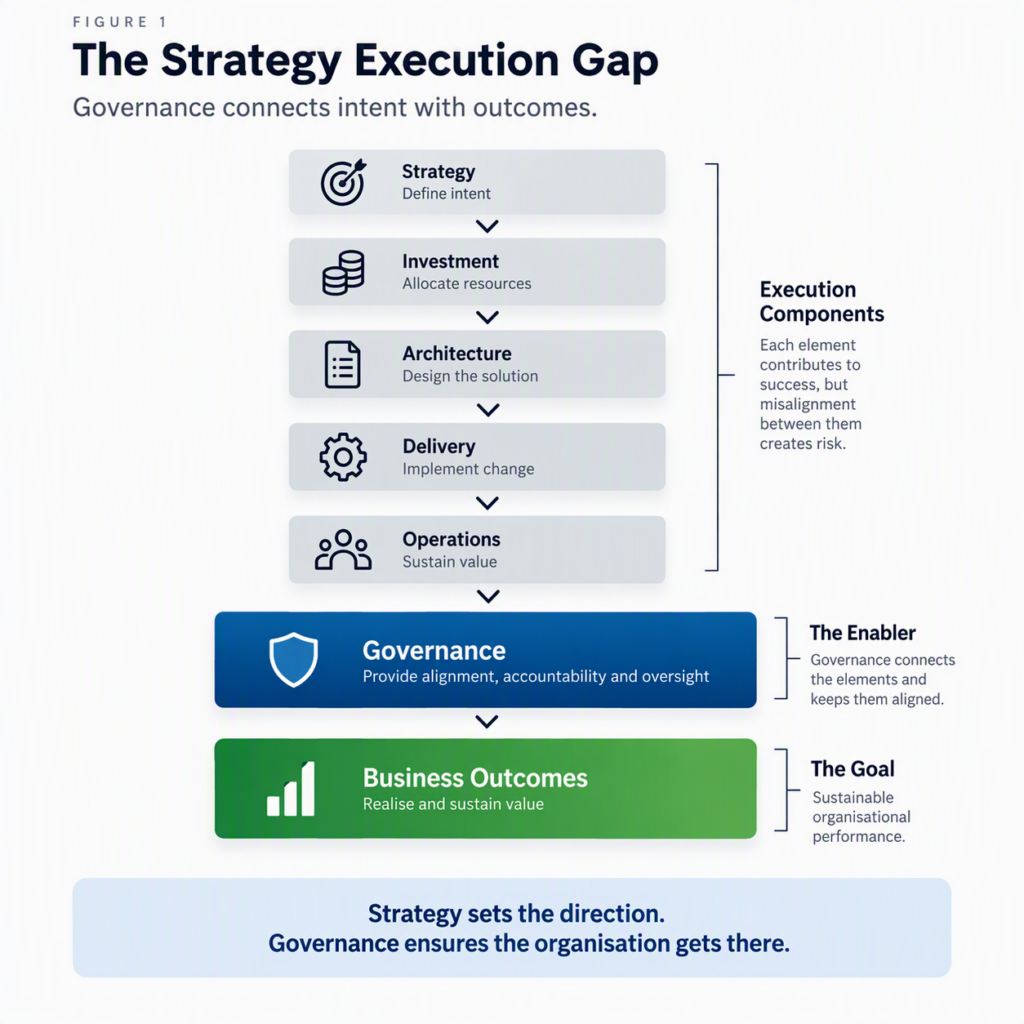
Figure 1. The Strategy Execution Gap
Most Organisations Don’t Have a Strategy Problem
Imagine a successful organisation entering its second decade of growth. Revenue is increasing, markets are expanding and customer expectations are evolving. The organisation has navigated economic uncertainty, invested in technology modernisation and acquired additional operational capability. By every measure, it appears healthy and successful.
Beneath the surface, however, the number of systems continues to grow. Different business units make independent investment decisions, reporting becomes inconsistent, projects compete for resources and architecture standards become difficult to enforce. Operational teams spend increasing amounts of time managing complexity rather than creating value.
Executives begin noticing the same themes in leadership discussions. Costs continue to rise despite investment, similar projects receive approval, reporting varies between departments, delivery teams struggle to agree on priorities, and transformation programmes produce fewer benefits than expected. These are governance questions, but they do not arise because the organisation lacks capable people. They emerge precisely because growth introduces complexity and sensible local decisions can create collective enterprise problems.
Governance is not designed to prevent growth. It is designed to ensure growth remains aligned, sustainable and manageable. Organisations seldom discover governance weakness in a single moment. Maturity degrades gradually as complexity increases faster than decision structures, controls and accountability mechanisms evolve; by the time the problem is obvious, the consequences are visible throughout the organisation.
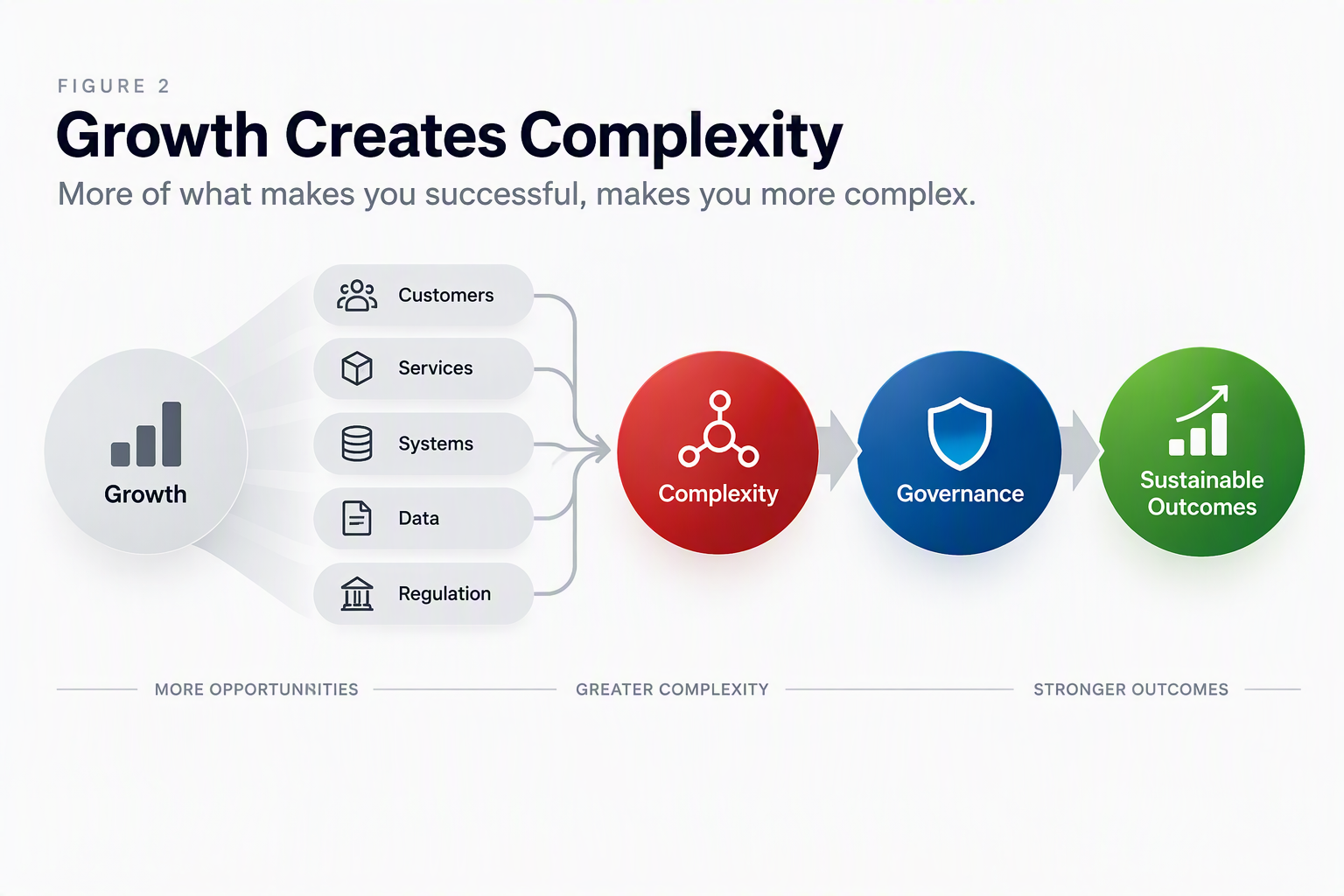
Figure 2. Growth Creates Complexity
The Governance Conversation Most Organisations Avoid
Governance is rarely discussed with the same enthusiasm as innovation, transformation or Artificial Intelligence. It often feels indirect because leaders can readily see the value of a new platform, product or growth initiative, whereas governance operates behind the scenes. People experience its effects every day without necessarily seeing the mechanism itself.
Its reputation has also been damaged by poor implementation. Many organisations experience governance as more approvals, more meetings and more reporting. When those activities become disconnected from business outcomes, governance is tolerated rather than valued and is treated like organisational insurance that matters only after something goes wrong.
The reality is that governance influences virtually every significant organisational outcome. Capital allocation, transformation sponsorship, architecture direction, risk appetite and benefits ownership all depend upon explicit or implicit governance choices. The question is therefore not whether governance exists, but whether it is intentional, proportionate and effective.
The Governance Myth
Perhaps the most damaging misconception is the belief that governance slows organisations down. This belief is understandable because many executives have experienced lengthy approval pathways, ineffective forums and complicated compliance processes. Poor governance creates friction; effective governance reduces uncertainty.
The difference can be compared to navigating a city. Roads, traffic controls and navigation systems impose structure, yet collectively improve movement because participants understand how to proceed safely and predictably. Governance serves the same purpose by clarifying decision authority, escalation pathways, accountability and risk visibility.
Attempts to increase agility by simply removing governance frequently produce the opposite result. Ambiguity increases, risks remain unresolved and decision-making slows because teams must renegotiate ownership and authority each time a problem arises. The objective should therefore never be less governance. It should be more effective governance.
What Good Governance Looks Like
Governance should be evaluated through outcomes rather than through the number of frameworks, committees or reporting cycles in place. Mature governance environments create observable behaviours that connect strategic intent to decisions and delivery.
| Strategic alignment | Priorities are understood, resources follow enterprise value and investment decisions support agreed objectives. |
| Decision effectiveness | Authority and escalation are clear, allowing timely and evidence-based decisions. |
| Visible accountability | Initiatives have sponsors, risks have owners and benefits have accountable leaders. |
| Proactive risk management | Risks surface early and can be addressed before they become operational crises. |
| Architecture alignment | Technology and design decisions support business priorities and future-state direction. |
| Outcome measurement | Success is measured through value, benefits, risk, performance and capability maturity. |
These characteristics do not emerge by accident. They develop through deliberate governance maturity and sustained executive attention. Clear priorities do not eliminate disagreement, but they provide a common reference point; visible accountability does not create blame, but it improves ownership; and architecture governance does not suppress innovation, but it helps innovation contribute to enterprise outcomes.
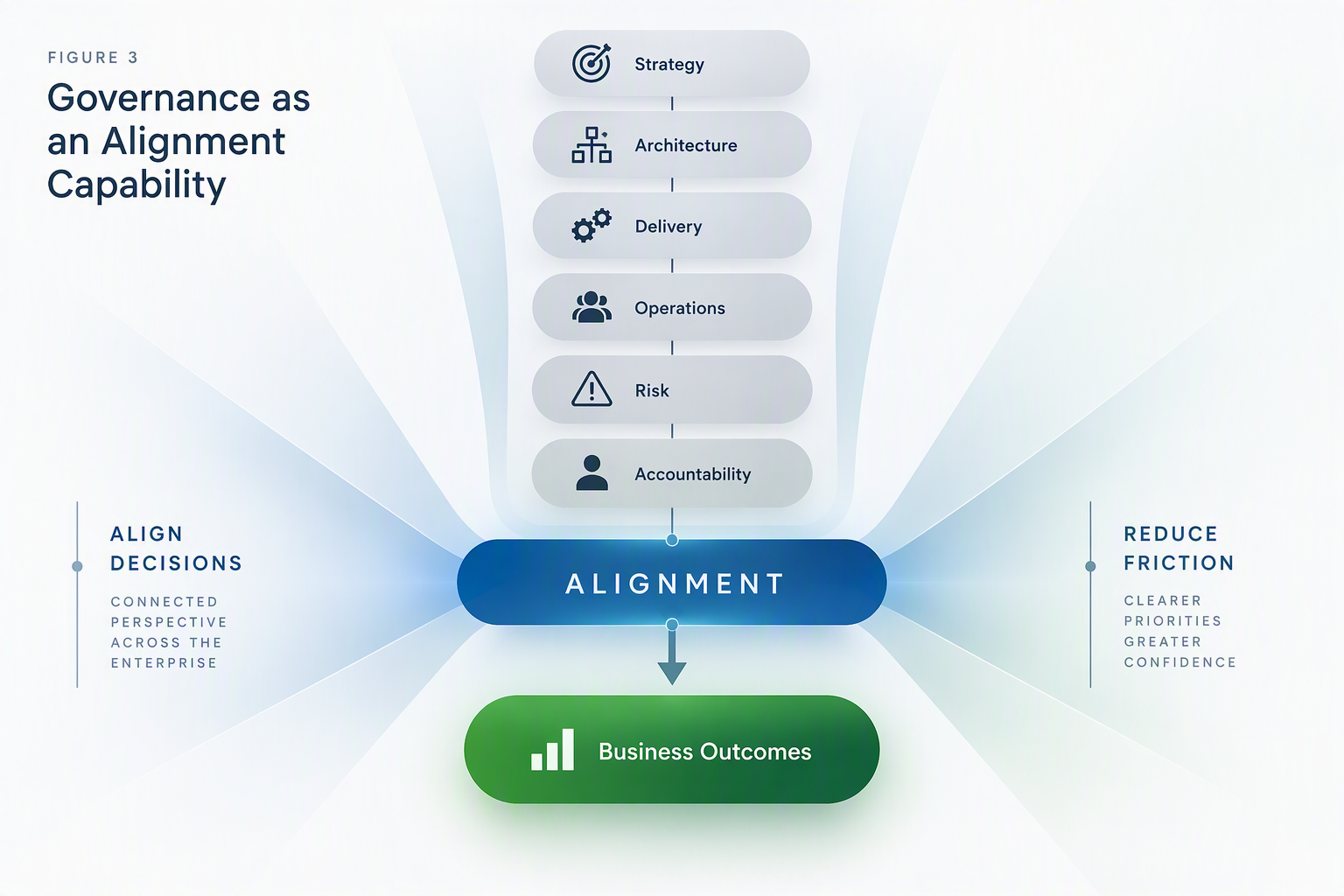
Figure 3. Governance as an Alignment Capability
Governance as a Business Capability
Many organisations continue to treat governance as an administrative obligation rather than as a capability. This limits improvement because administrative obligations are usually managed for compliance, while capabilities are assessed, measured, developed and matured.
Low-maturity environments depend heavily on individuals, apply governance inconsistently and respond to risk after it becomes visible. High-maturity environments use repeatable decision mechanisms, visible accountability, aligned architecture and proactive risk management. The objective is not to establish more structures, but to embed governance within how the organisation operates and performs.
The ProjPro Governance Equation
As organisations grow, business units expand, technology portfolios increase, customer expectations evolve and regulatory obligations become more demanding. Transformation programmes intended to reduce complexity can inadvertently introduce more of it when they solve individual problems without considering the broader enterprise.
ProjPro therefore views governance through the lens of organisational alignment. Effective governance maintains coherence across five interconnected dimensions. When these dimensions reinforce each other, the organisation is better positioned to produce sustainable outcomes; when alignment weakens, delivery initiatives compete, operational performance deteriorates and strategic objectives become progressively harder to achieve.
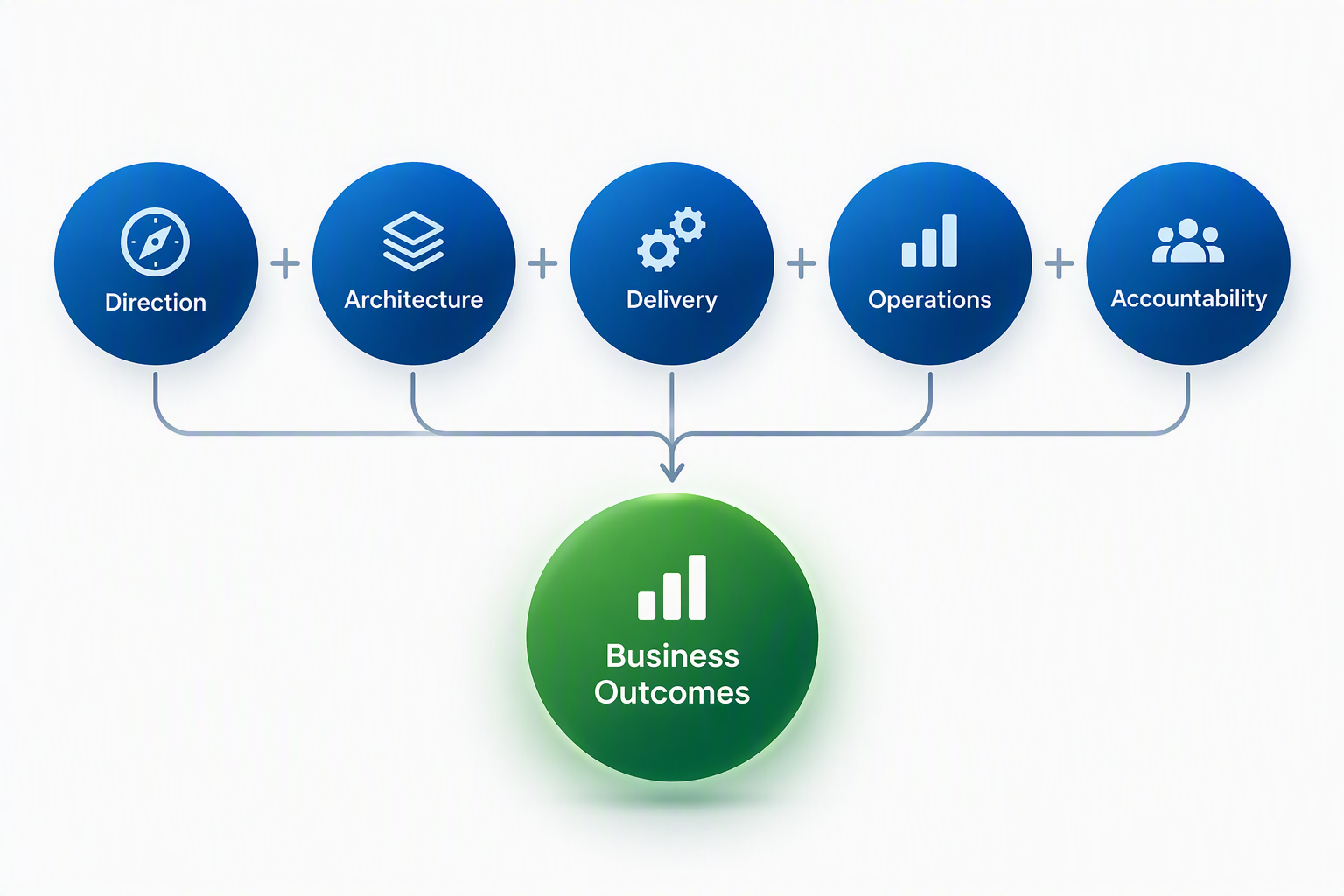
Figure 4. The ProjPro Governance Equation
| Dimension | Contribution |
|---|---|
| Direction | Establishes intent and clarifies what the organisation is trying to achieve. |
| Architecture | Provides the blueprint and clarifies how objectives should be realised. |
| Delivery | Converts plans into implemented change. |
| Operations | Sustains business value and supports continuous improvement. |
| Accountability | Maintains ownership across decisions, risks and outcomes. |
Governance Across Enterprise Architecture
Enterprise Architecture is often treated as a technology discipline and delegated to technology teams. This narrow interpretation creates risk because architecture should connect business strategy, capability, information, applications and technology. Without governance, investments evolve according to local priorities, integration becomes difficult, reporting fragments and technical debt accumulates.
A business unit may select a platform to meet an immediate need, while another team makes an equally rational decision elsewhere. Five years later, the enterprise may operate overlapping customer platforms, multiple reporting solutions, inconsistent integration approaches, duplicate data repositories and conflicting security models. No single decision created the problem; the cumulative effect emerged because decisions were not consistently evaluated through an enterprise lens.
Effective architecture governance establishes principles, standards, target architectures and review mechanisms that allow organisations to scale without unnecessary complexity. Its purpose is not to prevent innovation, but to ensure innovation contributes to long-term organisational success.
Governance Across Enterprise Domains
Project governance alone is insufficient because every enterprise domain makes decisions that influence performance, risk and value creation. ProjPro considers governance across Business, Data, Application, Technology, Security, Integration and Compliance (BDATSIC). The purpose is not to rank domains or imply fixed coverage. Governance emphasis changes with the decision and operating context, while the relationships between domains determine whether the organisation remains coherent.
| Enterprise domain | Governance focus |
|---|---|
| Business | Strategic direction, value, operating model and investment decisions. |
| Data | Ownership, quality, trust, lifecycle and decision information. |
| Application | Capability enablement, portfolio coherence and lifecycle management. |
| Technology | Platforms, infrastructure, resilience and sustainable investment. |
| Security | Risk, protection, resilience and trusted operation. |
| Integration | Ecosystem design, interoperability, information exchange and connected capability from strategy through operation. |
| Compliance | Obligations, permissions, controls, policies, standards and assurance. |
Integration and Compliance both begin at the strategic level and continue through architecture, delivery, improvement and operation. Integration Architecture establishes how the enterprise participates in ecosystems, shares information and connects capabilities, while Compliance translates obligations into policies, permissions, controls and assurance requirements. The central requirement is coherent governance across the relationships between all seven domains.
Governance in Practice: Lessons from Australia and New Zealand
Governance becomes easier to understand when examined through real events. Recent Australian and New Zealand examples demonstrate that governance quality influences public administration, cyber resilience, third-party accountability, digital investment and emerging technology adoption. The purpose of these examples is not to rank or criticise organisations, but to identify transferable lessons.
Robodebt Scheme
The Royal Commission identified significant failures relating to oversight, accountability, decision-making, legal compliance and challenge mechanisms. The wider lesson extends well beyond government: governance must be capable of testing assumptions and surfacing concerns before decisions scale into systemic harm.
Optus Data Breach
Public commentary and regulatory action extended beyond technical cyber controls to questions of privacy, risk ownership, information management and executive oversight. The lesson is that cyber security is not solely a technology concern; leadership governance determines whether risks are visible, prioritised and funded appropriately.
Latitude Financial Incident
The incident highlighted third-party access, information retention and accountability across outsourced ecosystems. Modern enterprises may rely on external service providers and technology partners, but accountability for customer information and organisational outcomes cannot be outsourced.
New Zealand Digital Government
The Digital Government Target State and related initiatives illustrate governance used to coordinate investment, reduce duplication, promote reuse and treat digital capability as a shared asset. The example demonstrates that governance can enable scale when it creates standards, visibility and coordinated decision-making across organisational boundaries.
Inland Revenue New Zealand Artificial Intelligence Capability Initiative
The structured use of executive oversight, governance groups and capability development illustrates the value of maturing governance alongside emerging technology. Organisations that establish governance before technology becomes an operational dependency are better positioned to manage risk while capturing value.
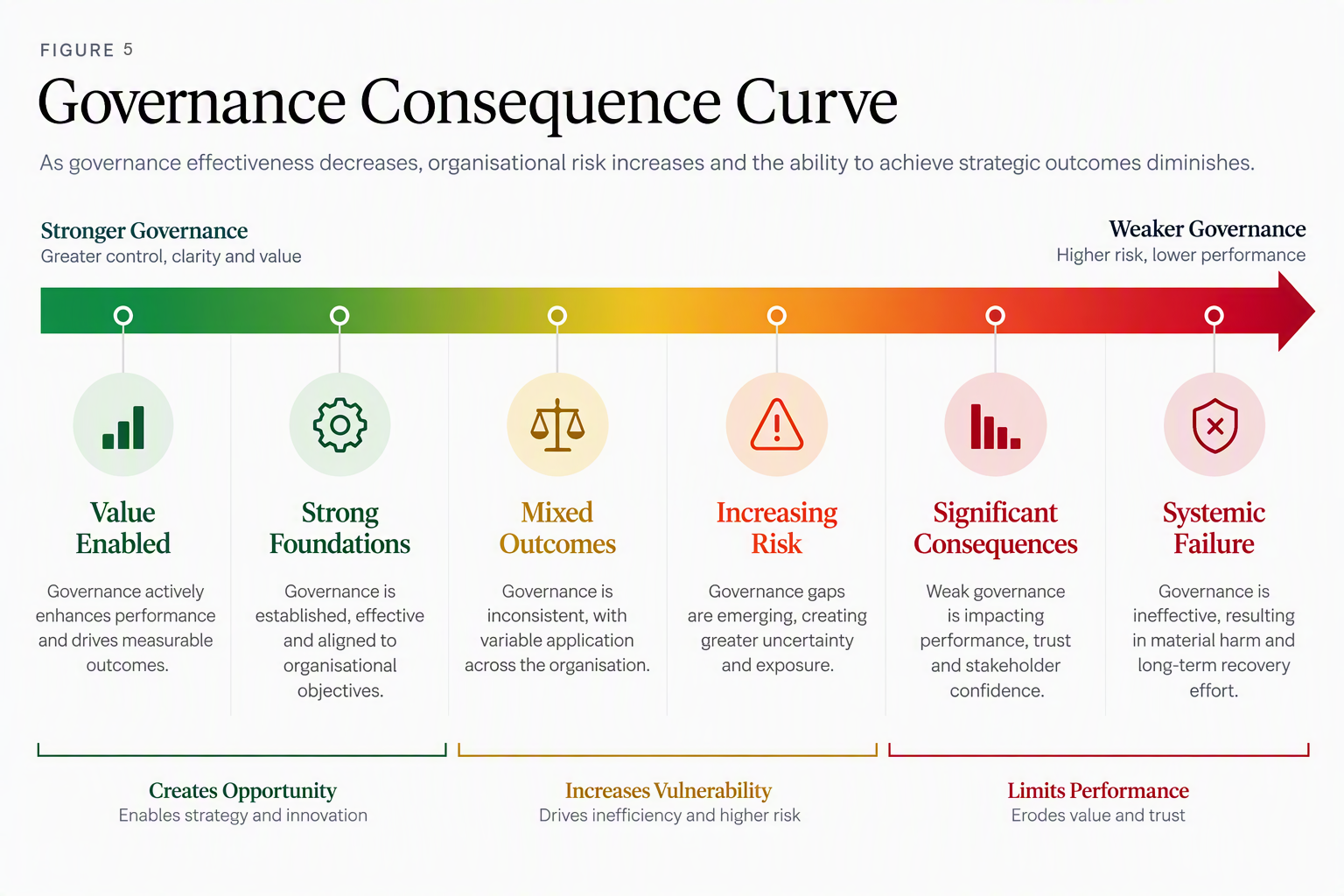
Figure 5. Governance Consequence Curve
The Governance Consequence Curve provides a neutral way to interpret these lessons. Readers can evaluate where an organisation, initiative or governance capability sits based on observable outcomes, ranging from value enablement and strong foundations to increasing risk, material consequences and systemic failure.
Governance Across Enterprise Architecture Operations
Governance is frequently implemented as a separate organisational activity, which can disconnect it from operational reality. Enterprise Architecture Operations takes a different approach by embedding governance throughout strategy, architecture, delivery, improvement and regulation. This whitepaper does not attempt to explain the detailed EAOps authority and operating model; that model should be addressed in a dedicated publication.
| EAOps practice | Governance focus |
|---|---|
| Strategise & Transform | Strategic governance and investment prioritisation. |
| Architecture & Design | Architecture governance and future-state alignment. |
| Deliver & Execute | Transformation governance, assurance and risk management. |
| Optimise & Improve | Performance governance and continual improvement. |
| Operate & Regulate | Operational governance, compliance and sustainability. |
The essential point is continuity. Governance should not be added at the end of delivery or activated only when a problem occurs. It must remain relevant from strategic direction through design, execution, optimisation and ongoing operation.
Governance Maturity Model
Governance capability develops through maturity stages. A maturity model allows organisations to identify strengths, gaps and realistic improvement pathways without assuming that every capability must advance at the same rate.
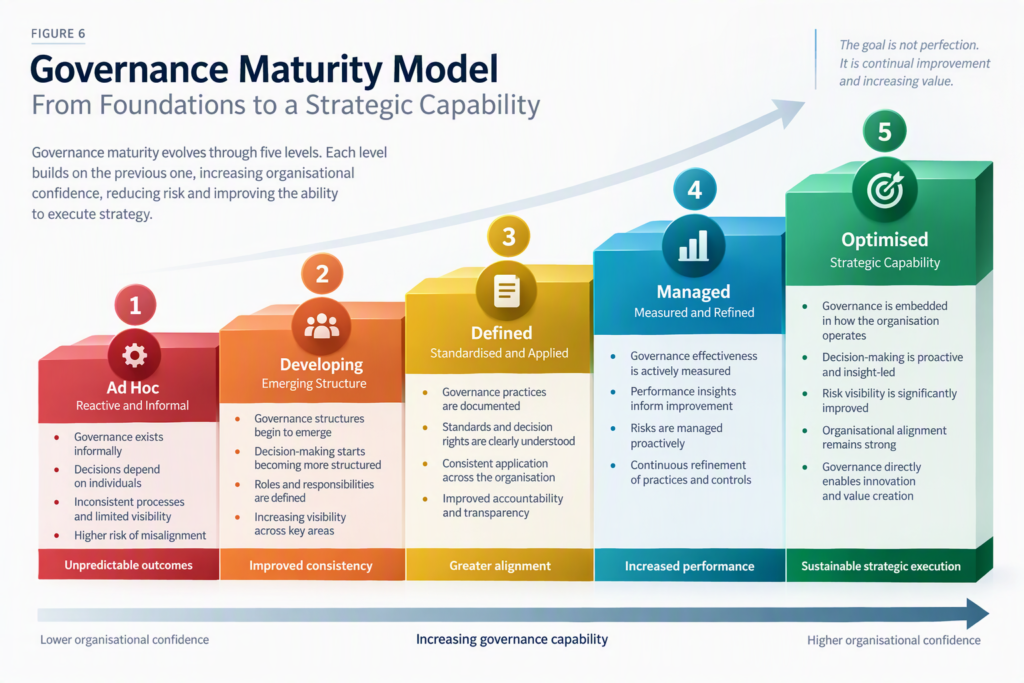
Figure 6. Governance Maturity Model
Governance maturity progresses through five cumulative levels.
- At Level One, governance is informal, reactive and dependent upon individuals.
- Level Two introduces emerging structures, clearer roles and more consistent decision-making.
- Level Three establishes documented practices, understood decision rights and repeatable application across the organisation.
- Level Four measures governance effectiveness and uses performance insight to refine risk management, controls and decision-making.
- At Level Five, governance is embedded as a strategic capability that supports proactive decisions, stronger alignment, innovation and sustainable value creation.
The goal is not governance perfection; it is continual improvement and increasing organisational confidence.
The Cost of Poor Governance
Governance failures rarely present themselves as governance failures. They appear as missed deadlines, rising technology costs, deteriorating customer experience, cyber incidents, regulatory concerns and underperforming strategic initiatives. These symptoms influence financial outcomes, customer trust and operational effectiveness, making poor governance one of the most expensive problems organisations often fail to recognise.
Seven Governance Failure Patterns
| Failure pattern | Business consequence |
|---|---|
| Governance theatre | Forums and reporting exist, but meaningful decisions do not occur. |
| Architecture without authority | Architecture guidance lacks influence over investment and delivery decisions. |
| Unclear accountability | Ownership is fragmented, delaying decisions and weakening outcomes. |
| Excessive governance | Process becomes more important than value, creating avoidable friction. |
| Compliance-only governance | Governance becomes disconnected from strategy and outcomes. |
| Technology-centric governance | Platforms and controls are emphasised without maintaining business alignment. |
| Weak executive sponsorship | Governance lacks legitimacy and is inconsistently applied. |
Recognising these patterns early enables organisations to intervene before governance weaknesses compound into material performance, risk or reputational consequences.
Seven Governance Practices of High-Performing Organisations
| Practice | What it enables |
|---|---|
| Clear decision rights | Authority and escalation pathways are documented and understood. |
| Organisational principles | Agreed principles guide consistent trade-offs and decisions. |
| Empowered governance forums | Forums decide rather than merely review information. |
| Integrated governance | Governance is embedded into delivery and operations. |
| Outcome measurement | Performance is assessed through value, benefits and risk rather than activity volume. |
| Transparency | Issues and risks can be surfaced without distortion or delay. |
| Continuous improvement | Governance evolves as complexity, technology and obligations change. |
ProjPro Perspective
ProjPro believes governance has suffered from decades of poor positioning. It is too frequently presented as control, even though control alone rarely motivates people, enables innovation or produces sustainable change. Governance should instead be understood as a capability that creates confidence: confidence to invest, innovate, take calculated risk and execute transformation.
This changes the governance conversation. Rather than asking how much governance is required, organisations can ask how governance can improve performance. The answer lies in proportionate, outcome-focused mechanisms that connect strategy, architecture, delivery, operations and accountability throughout the enterprise lifecycle.
Conclusion
The organisations described throughout this article may possess talented people, capable leaders and substantial transformation investment, yet their outcomes can differ markedly. The difference is not simply intelligence, technology or effort. It is the ability to maintain alignment as complexity increases.
Effective governance ensures decisions remain connected to strategic objectives, architecture supports business outcomes, risks remain visible and accountability remains clear. Organisations that build governance as a strategic capability are better positioned to adapt, innovate and sustain value than those that treat governance as an administrative necessity.
| CLOSING PERSPECTIVE: Good governance creates organisational confidence, and confidence remains one of the most valuable assets available to a modern organisation. |