Optimise & Improve
Optimise Performance. Unlock Enterprise Value.
PROCESS IMPROVEMENT, OPERATIONAL EXCELLENCE & AUTOMATION.
Turn operational insight into measurable improvement and sustained value. Operational performance evolves as processes, technology and operating conditions change.
ProjPro helps organisations identify what is constraining performance, improve the right processes and operating conditions, and demonstrate measurable outcomes that can be sustained.
Whether the starting point is one underperforming process, a broader operational challenge or a newly delivered capability moving into operation, we help customers find the constraint, improve the work and prove the result.
OPTIMISE & IMPROVE
Could your operations deliver more value from the capabilities you already have?
Operational performance does not stand still.
Processes evolve as organisations grow. New requirements introduce additional steps. Teams develop practical workarounds. Information passes through more hand-offs. Demand and capacity change. Technology creates new possibilities. Successfully delivered capabilities encounter operating conditions that could not always be fully anticipated during design and implementation.
None of this automatically means that an organisation, process or team is failing.
It means there may be opportunities to improve cycle time, throughput and capacity; cost, productivity and utilisation; quality, accuracy and consistency; customer and employee experience; workflow, hand-offs and decision latency; service levels and operational resilience; technology and automation enablement; and realised value from previous investment.
Most organisations can identify many things that could change. The harder questions are:
-
- What is materially affecting performance?
- What is a symptom and what is the underlying cause?
- Which opportunities are worth pursuing?
- What level of intervention is proportionate?
- Where could technology genuinely create value?
- Did the completed improvement deliver the expected outcome?
Effective improvement begins by answering those questions with evidence.
WHAT EFFECTIVE IMPROVEMENT LOOKS LIKE
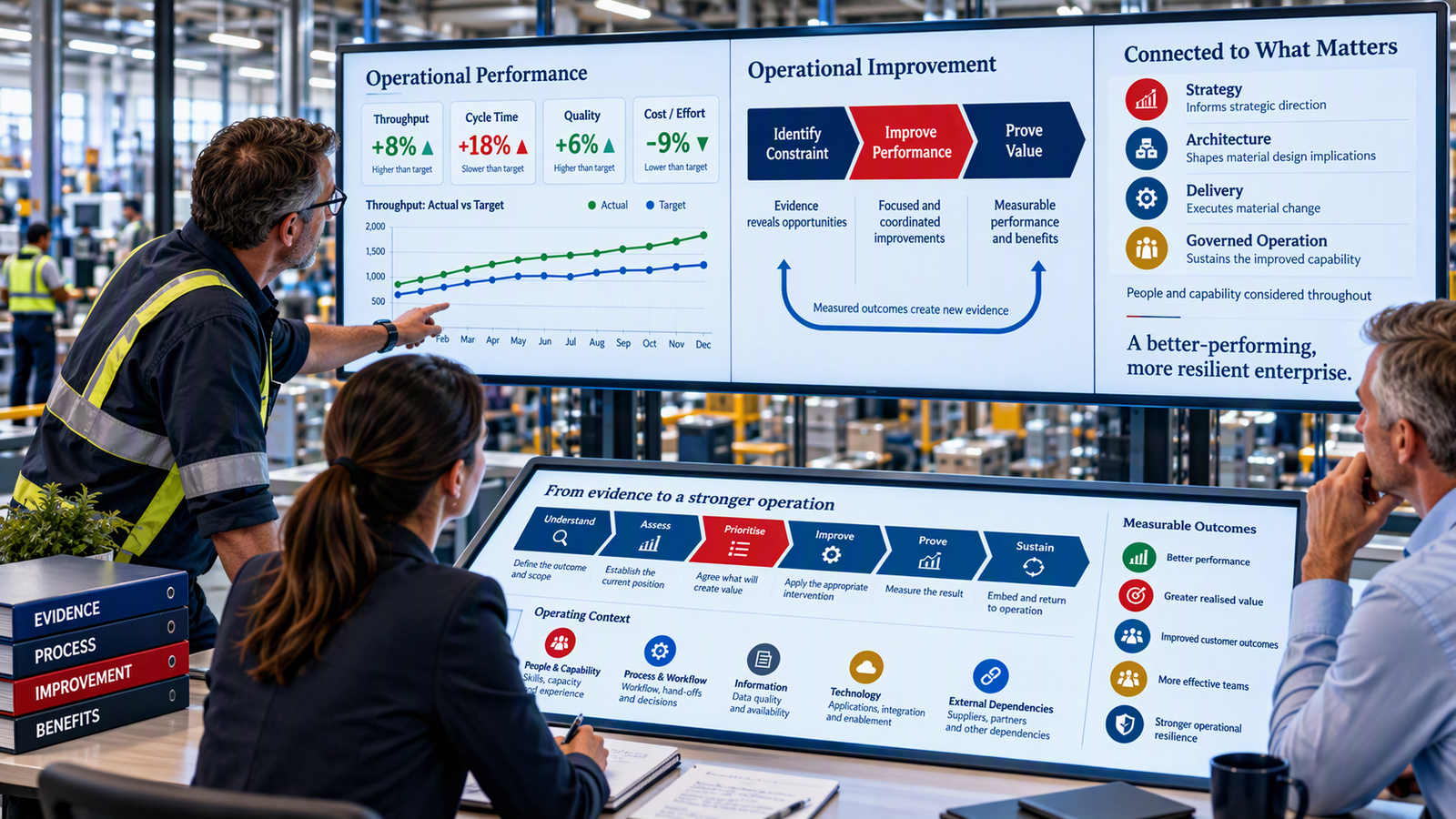
Performance improves when the operation is understood as a system.
A process rarely performs in isolation. Operational outcomes emerge from the interaction of people and capability; process and workflow; information and data; applications and technology; demand, capacity and scheduling; decisions, approvals and hand-offs; suppliers and operational dependencies; controls and obligations; and customer and employee experience.
Improving one activity without understanding those relationships can move a constraint elsewhere, create unintended consequences or produce local efficiency at the expense of the wider outcome.
-
- Establish the outcome that matters.
- Assess the evidence-based current position.
- Distinguish symptoms from underlying causes.
- Identify the intervention most likely to create value.
- Apply improvement at the appropriate scale.
- Measure whether performance changed.
- Embed ownership so that the result can be sustained.
Enable the operation appropriately effective, efficient, resilient and capable of delivering the outcomes required.

PROJPRO PERSPECTIVE
Understand the cause before prescribing the improvement.
ProjPro does not begin with a preferred methodology, technology platform or predetermined solution. We begin with the performance concern and the outcome that matters.
An assessment establishes the evidence-based current position: what is expected; what is happening in practice; where performance differs; what evidence supports the finding; which conditions contribute to the result; what the underlying cause appears to be; why the condition matters; and how confidently a conclusion can be reached.
Symptom → Evidence → Contributing factor → Root cause → Business implication
Treating the symptom may create activity without changing the outcome. Understanding the cause provides a defensible basis for determining whether the operation should be refined, remediated or protected through prevention.
Evidence before intervention
Recommendations remain traceable to a supported operational finding.
Proportionate response
A focused problem should not automatically become a large programme.
Enterprise context
The process is considered in relation to people, information, technology, dependencies and obligations.
Disciplined automation
Unnecessary work should not be automated merely because it can be.
Proof of value
Completing an intervention is not the same as demonstrating improvement.
Diagnose with evidence. Improve proportionately. Prove the result.
How ProjPro Can Help
Improvement can start wherever operational value is constrained.
ProjPro provides three distinct but complementary approaches to improve and optimise operational outcomes.
Process & Performance Improvement
How can this work perform better?
We help organisations understand and improve individual processes, workflows, services and value streams.
The purpose is not process documentation for its own sake. It is to identify the activities and conditions that materially affect performance, redesign the work where justified and measure whether the expected improvement was realised.
Outcome: Simpler, more effective processes supported by measurable performance improvement.
Operational Optimisation
How can the operating system around the work perform better?
Performance may be shaped by demand, capacity, schedules, organisational interfaces, information, applications, suppliers, decisions, controls and cross-functional dependencies.
ProjPro helps customers understand and improve the broader operating environment, particularly where local improvements have not addressed the wider constraint.
Outcome: A better-performing operating system rather than isolated local improvements.
Automation & Intelligent Process Improvement
Where can technology genuinely improve operational value?
Automation is not automatically improvement.
ProjPro first examines whether work should be removed, simplified, standardised or redesigned. Technology is then applied where it materially improves the outcome.
Eliminate → Simplify → Standardise → Optimise → Automate
Outcome: Purposeful technology-enabled improvement connected to operational value.
ASSESSMENT, EVIDENCE & MATURITY
Establish the true position before deciding what should change.
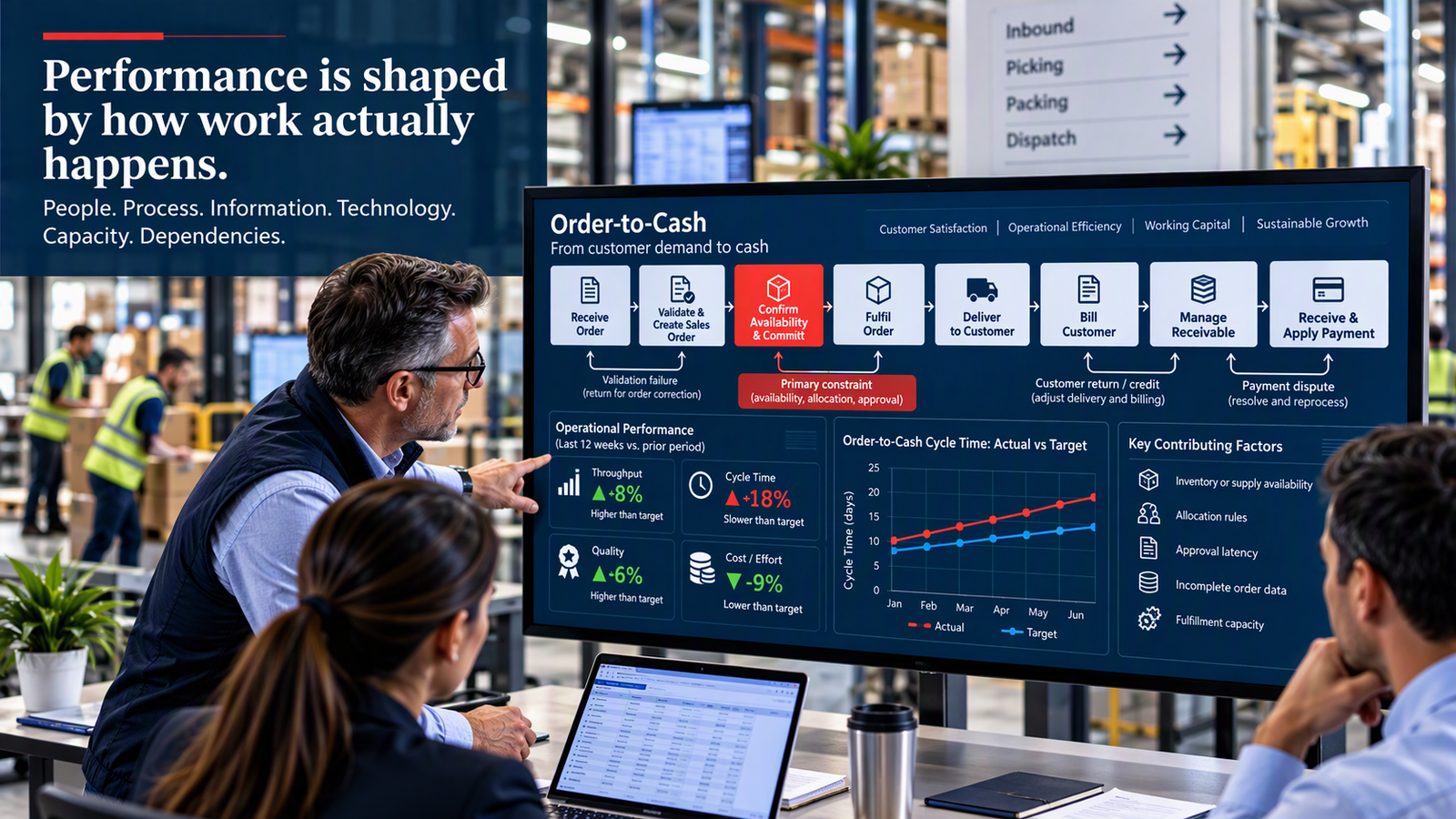
An assessment is scaled to the performance concern. A focused process issue should not carry the burden of an enterprise-wide diagnostic. Equally, a systemic operating problem should not be reduced to a superficial process workshop.
Performance
Cycle time, throughput, demand and capacity, productivity, utilisation, cost, quality, rework, service levels, customer or employee outcomes and realised benefits.
Process & Workflow
Activities, sequence, hand-offs, queues, approvals, exceptions, variation, duplication, manual intervention, information movement and technology support.
Operating Context
Stakeholder needs, organisational boundaries, schedules, suppliers, applications, controls, obligations, dependencies, previous changes and planned initiatives.
Capability & Maturity
The ability to establish, implement and sustain the improvement required.
Universal maturity model
1 Initial → 2 Developing → 3 Defined → 4 Managed → 5 Optimised, plus N/A Not Assessed.
Maturity is not an organisational scorecard, and Level 5 is not automatically the objective. It helps determine whether the current capability supports the required outcome, whether an intervention can be sustained, what level of change is realistic and where enabling capability needs strengthening.
Evidence confidence
A finding distinguishes between confirmed evidence, strongly supported interpretation, plausible contributing factor, untested assumption and evidence gap.
The result is an evidence-based current-position view connecting Observation → Interpretation → Cause → Implication → Opportunity.
FROM CONCERN TO SUSTAINED IMPROVEMENT
From performance concern to sustained improvement.
ProjPro uses a six-stage customer method that preserves traceability from the original performance concern through assessment, intervention and realised outcome.
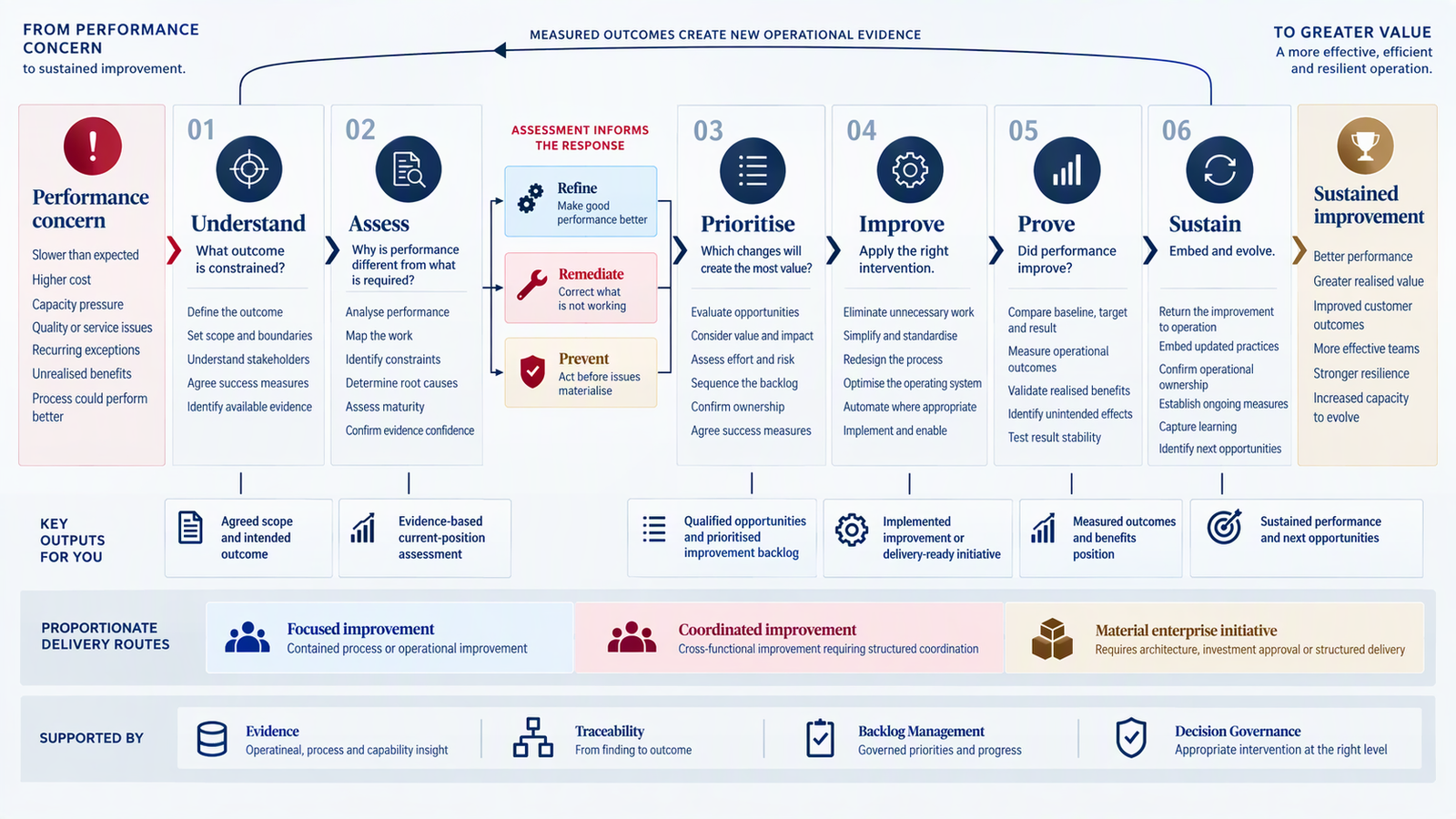
01 Understand
What outcome is constrained?
Establish the concern, intended outcome, scope, stakeholders, existing measures, available evidence and definition of success.
02 Assess
Why is performance different from what is required?
Examine operational and process performance, workflows, demand, capacity, variation, systems, dependencies, root causes, maturity and evidence confidence.
Diagnostic path: Symptom → Evidence → Cause → Implication.
03 Prioritise
Which changes will create worthwhile value?
Determine whether to Refine, Remediate or Prevent, then evaluate opportunities against value, impact, urgency, risk, effort, feasibility, readiness, dependencies, evidence confidence and time to value.
04 Improve
What proportionate intervention is appropriate?
Interventions may be focused, coordinated or a material enterprise initiative. Improvement may eliminate unnecessary activity, simplify or standardise work, redesign workflow, resolve constraints, improve information or apply appropriate automation.
05 Prove
Did performance improve?
Compare baseline, target and result; measure operational outcomes; validate realised benefits; identify unintended effects; and test result stability.
Evidence chain: Baseline → Intervention → Result → Benefit.
06 Sustain
Can the result be maintained in normal operation?
Return the improvement to operation, embed updated working practices, confirm operational ownership, establish ongoing measures, capture learning and identify justified next opportunities.
FROM MOBILISATION TO OUTCOMES
Maintain control from mobilisation through transition and outcomes.
ProjPro establishes the delivery environment, confirms responsibilities and baselines, integrates controls, leads execution, assures evidence, coordinates transition and supports stabilisation until ownership and outcomes are clear.
Integrated Programme Control spans timelines, resources and workstreams, stakeholders, vendors, finance, change management, Risks, Actions, Assumptions, Issues, Dependencies and Decisions Management (RAAIDD), onboarding and offboarding, reporting, quality, testing, cutover, deployment and transition.
The detailed lifecycle and operational evidence loop are represented in the Integrated Delivery Model rather than duplicated as a second process.
WHAT YOU RECEIVE
Clear evidence. Actionable priorities. Measurable outcomes.
Deliverables reflect the engagement scope and outcomes required. ProjPro does not impose the same deliverables on every engagement.
Position and evidence
Assessment scope and outcome, current-position assessment, performance baseline, process or value-stream view, workflow analysis, operating-context view, evidence-confidence assessment and maturity assessment.
Diagnosis and decision
Constraint and dependency analysis, root-cause findings, qualified opportunities, Refine/Remediate/Prevent classification, prioritisation rationale and the improvement backlog.
Design and implementation
Future-state process or workflow, improvement recommendations, roadmap, automation opportunity and value case, intervention plan, delivery-ready definition and updated operating artefacts.
Measurement and sustainability
Targets and success measures, outcome and benefit measures, post-implementation performance assessment, benefits-realisation position, operational ownership and sustainability actions.
A credible understanding of the problem, an agreed basis for action and evidence of whether performance improved.

WAYS TO ENGAGE
Start with the performance challenge.
A delay may originate in a hand-off, capacity constraint, approval, control, information gap or system limitation. A process may appear ready for automation when unnecessary complexity should first be removed. A newly delivered capability may be operating as designed without yet producing the expected business benefit.
ProjPro helps organisations establish what is actually happening, understand why performance differs from what is required and determine which intervention will create worthwhile value.
Whether the starting point is one underperforming process, a broader operational challenge or a newly delivered capability moving into operation, we help customers find the constraint, improve the work and prove the result.
Focused Process Assessment
Best suited when: a process, service or workflow is underperforming, or the underlying cause is unclear.
Focus: scope, current performance, evidence, constraints, causes and improvement opportunities.
Targeted Process Improvement
Best suited when: the performance problem is sufficiently understood to proceed into redesign and implementation.
Focus: simplification, workflow redesign, constraint removal, implementation and performance measurement.
Operational Optimisation
Best suited when: performance is affected by multiple processes, teams, functions, systems or dependencies.
Focus: the wider operating system, cross-functional performance, capacity, interfaces, information flows and systemic constraints.
Automation & Intelligent Process Improvement
Best suited when: workflow, integration, automation, data or artificial intelligence may improve performance.
Focus: remove unnecessary work, simplify and standardise processes, assess technology opportunities and develop credible value cases.
Benefits Recovery & Post-Implementation Optimisation
Best suited when: a delivered capability is operating but intended benefits are unclear, delayed or not being realised.
Focus: intended outcomes versus actual operational performance.
Improvement Capability Enablement
Best suited when: the organisation wants to strengthen its own improvement capability.
Focus: assessment methods, evidence disciplines, prioritisation, improvement backlogs, process ownership and measurement.
WHY PROJPRO
Improvement connected to the enterprise around it.
Operational improvement is often weakened by one of two extremes. The first treats the problem as local and overlooks the wider cause. The second turns every problem into a major transformation and introduces more intervention than the situation requires.
ProjPro takes a different approach.
-
- Evidence-led: establish the current position and distinguish symptoms from causes before recommending change.
- Operationally grounded: work with functional leaders, process owners, operational and production management, subject-matter experts and people closest to the work.
- Context-aware: consider process, people, information, technology, capacity, controls, obligations and operating conditions together.
- Proportionate: keep focused problems focused; broaden intervention only where evidence justifies it.
- Implementation-oriented: move beyond assessment and recommendations where the agreed responsibility model requires implementation.
- Automation-disciplined: eliminate, simplify and standardise before automating.
- Outcome-focused: use baselines, targets and evidence to demonstrate realised operational value.
- Connected: maintain evidence and context when material implications move into strategy, architecture, delivery or governed operation.
- Capability-building: strengthen the customer's ability to sustain improvement without creating unnecessary dependence on ProjPro.
WHAT HAPPENS NEXT?
A proportionate path from concern to action.
- Discuss. Clarify the outcome, decision or delivery concern that matters.
- Scope. Agree the delivery boundary, evidence, stakeholders, responsibilities and intended outcomes.
- Assess or Mobilise. Assess where evidence is needed, or mobilise directly where the required engagement is already clear.
- Decide. Confirm what action is justified by evidence, materiality, accountability and value.
- Execute, Assure & Transition. Deliver with clear ownership, embedded assurance, controlled transition and measurable outcomes.
FREQUENTLY ASKED QUESTIONS
Questions process leaders often ask.
Can we engage ProjPro for one process or performance problem?
Yes. Optimise & Improve is a discrete service. We can begin with one process, service, workflow, constraint or operational-performance concern and scale the engagement only where the evidence justifies broader intervention.
Do we need to know the cause before engaging ProjPro?
No. Establishing the evidence-based current position and distinguishing symptoms from their underlying causes is part of the engagement. We begin with the performance concern and the outcome that matters, then determine what the evidence supports before recommending change.
Does ProjPro only assess and recommend?
No. Depending on the agreed scope and responsibility model, ProjPro can assess, redesign, implement and measure operational and process improvements. A contained improvement can remain focused. Where the evidence identifies a more material architectural or delivery requirement, the initiative can progress through the appropriate pathway without losing the context and value case that established the need.
How does ProjPro approach automation and artificial intelligence?
Technology is applied where it improves the outcome, not simply because something can be automated. Our approach is: Eliminate → Simplify → Standardise → Optimise → Automate. This helps avoid automating unnecessary complexity and connects technology investment to a supported operational need and measurable value.
How is Optimise & Improve different from Deliver & Execute and Operate & Regulate?
Deliver & Execute implements consequential change and transitions capability into operation. Optimise & Improve diagnoses and improves the performance of processes, services and operating systems. Operate & Regulate sustains the ongoing governance, controls, reporting and operating disciplines required to operate effectively and responsibly. Where an improvement becomes a material change initiative, it can move into Deliver & Execute. Once improved, the capability returns to governed operation.
How do we know whether the improvement actually worked?
We establish an appropriate baseline, target and outcome measures so the intervention can be evaluated against evidence. The logic is straightforward: Baseline → Intervention → Result → Benefit. Completion of an activity is not treated as proof of improvement. The objective is to determine whether performance changed as intended and whether the resulting benefit can be sustained.
START THE CONVERSATION
Start with the performance concern that matters to you.
You do not need to have diagnosed the cause or designed the solution before speaking with ProjPro.
You may have a process taking too long, recurring rework or exceptions, capacity or productivity pressure, inconsistent service or quality, a workflow with too many hand-offs, technology that is not producing expected value, an automation opportunity requiring validation, benefits from previous investment that remain unclear or an operating environment that should perform better as a whole.
We can begin by understanding what outcome matters, what the available evidence indicates, where performance appears constrained and what level of intervention is appropriate.
From there, we can determine whether the right next step is a focused assessment, a targeted process improvement, broader operational optimisation, automation and intelligent process improvement, benefits recovery or improvement capability enablement.
Make operational performance better.
By clicking the button, you agree to our terms and conditions and privacy policy.
This site is protected by reCAPTCHA and the Google privacy policy and terms of service apply.