EAOps
Make enterprise improvement operational.
ENTERPRISE ARCHITECTURE OPERATIONS

Connect requirements, architecture, delivery, governance and operations through one evidence-led framework for continual enterprise improvement.
OVERVIEW
Dynamically improving the enterprise.
EAOps is the Enterprise Architecture Operations framework for connecting strategic direction, enterprise design, programme delivery, operational governance and continual improvement. It is designed to help organisations manage transformation as an enduring enterprise capability, not as a sequence of disconnected projects.
Why EAOps Exists
Transformation becomes difficult when executive priorities, requirements, architecture decisions, programmes, suppliers, operational controls and performance evidence are managed in isolation. EAOps creates a governed operating model through which these elements remain connected from strategic intent to sustained enterprise value.
THE EAOPS MODEL
The EAOps Reference Model
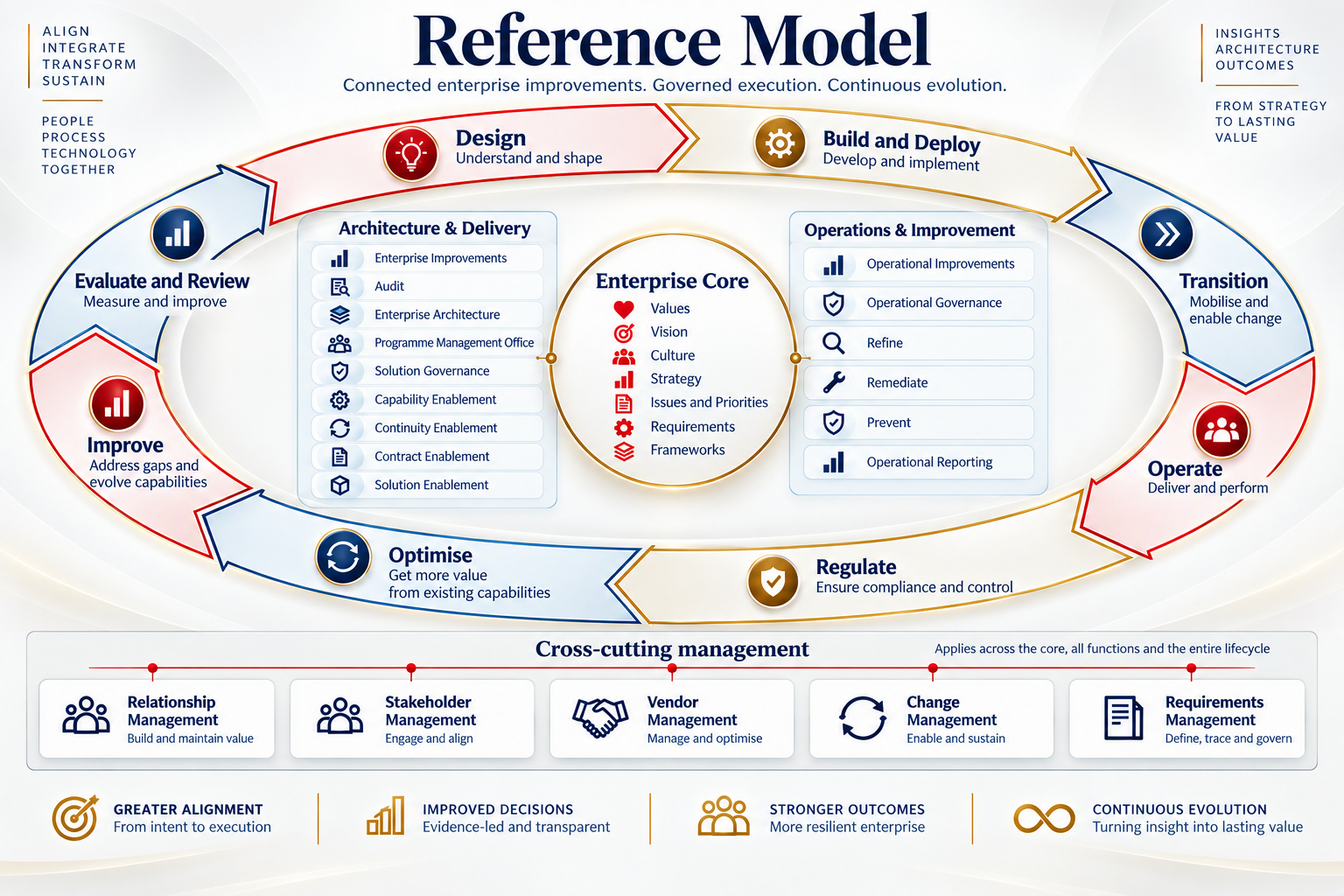
The reference model places the Enterprise Core at the centre: Values, Vision, Culture, Strategy, Issues and Priorities, Requirements and Frameworks. Architecture and delivery functions sit alongside operations and improvement functions within a continuous cycle of Design, Build and Deploy, Transition, Operate, Regulate, Optimise, Improve, and Evaluate and Review. Relationship, stakeholder, vendor, change and requirements management apply across the core, all functions and the entire lifecycle.
EAOPS - ENTERPRISE IMPROVEMENTS
Enterprise Core
The Enterprise Core defines the enduring context against which change is assessed and governed. Requirements form part of the core because requirements translate strategic direction, stakeholder needs, obligations, operational conditions and intended outcomes into controlled statements that architecture, delivery and operations can implement and evidence.
Requirements Management
Requirements Management is a continuous, cross-cutting EAOps discipline that preserves alignment between strategic intent, stakeholder needs, enterprise architecture, delivery commitments, operational controls and measurable outcomes. EAOps manages requirements from identification and analysis through approval, baselining, realisation, verification, acceptance, operational evaluation, change and retirement. Requirements remain bidirectionally traceable to their source, affected architecture domains, decisions, implementation elements, acceptance evidence and operational outcomes.
Requirements Taxonomy
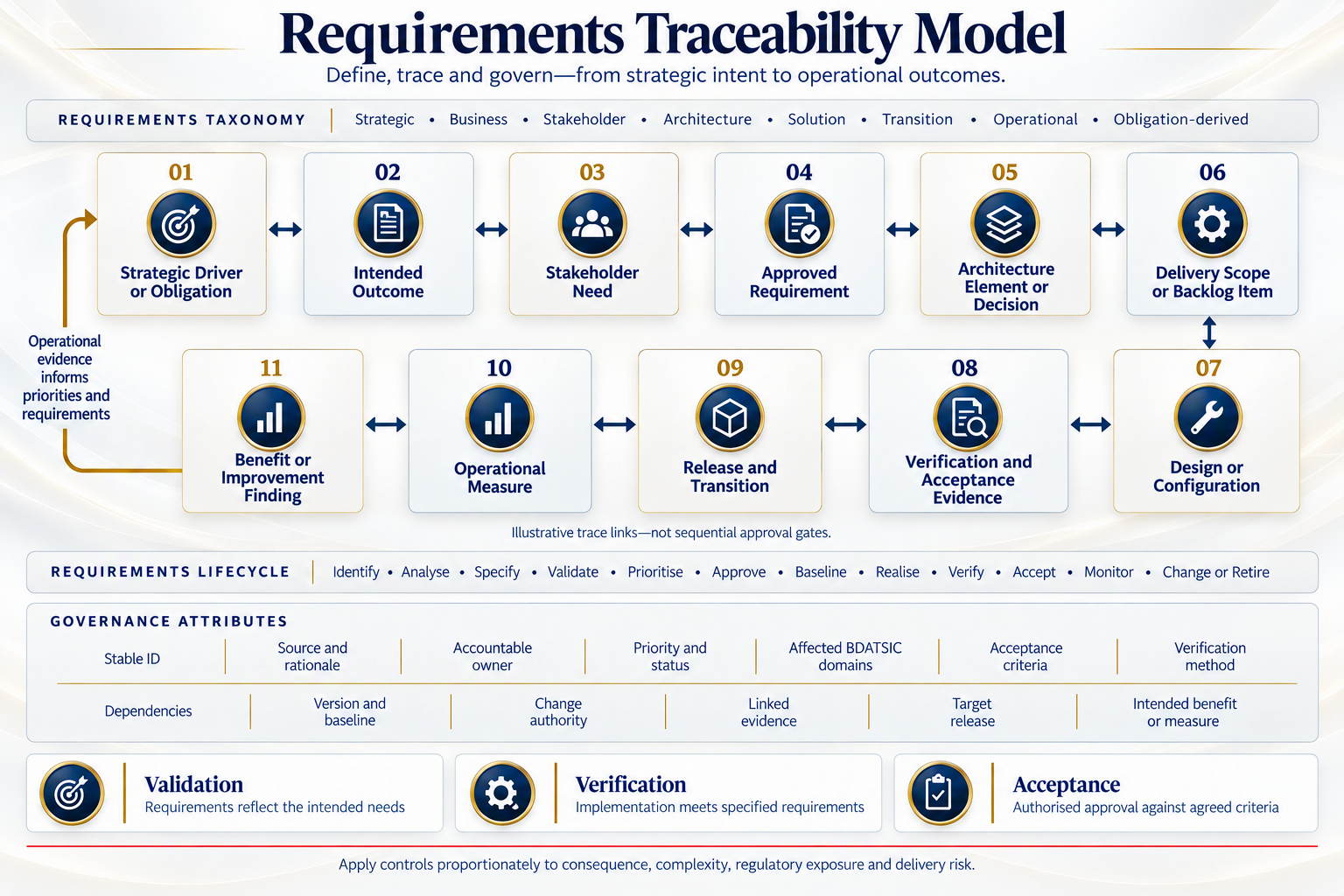
EAOps distinguishes strategic, business, stakeholder, architecture, solution, transition, operational and obligation-derived requirements. The taxonomy prevents strategic needs, architecture constraints, user stories, technical specifications and acceptance evidence from being treated as interchangeable. Requirements may be progressively elaborated while retaining their upstream rationale and downstream evidence.
Requirements Lifecycle and Traceability
The governed lifecycle is Identify, Analyse, Specify, Validate, Prioritise, Approve, Baseline, Realise, Verify, Accept, Monitor, and Change or Retire. Traceability connects Driver or Obligation, Intended Outcome, Stakeholder Need, Approved Requirement, Architecture Element or Decision, Delivery Scope or Backlog Item, Design or Configuration, Verification and Acceptance Evidence, Release and Transition, Operational Measure, and Benefit or Improvement Finding. Controls are applied proportionately to consequence, complexity, regulatory exposure and delivery risk.
Governed Requirement Information
Each material requirement should have a stable identifier, type, source and rationale, accountable owner, priority and status, affected BDATSIC domains, acceptance criteria, verification method, trace links, dependencies, version and baseline, change authority, linked evidence, target release or transition, and intended benefit or measure. Validation establishes that it is the right requirement. Verification establishes that the requirement was implemented correctly. Acceptance records that authorised evidence and outcomes were accepted.
EAOPS GOVERNANCE & ENABLEMENT
Architecture, Programme and Solution Governance
Enterprise Architecture establishes coherent enterprise direction and relationships. The Programme Management Office coordinates investment, sequencing, resources, dependencies and delivery control. Solution Governance applies policies, frameworks, standards, contracts, release controls, communications and escalation routes. Requirements impact assessments identify the consequences of proposed changes across architecture, delivery, security, compliance, transition, operations and benefits.
Capability, Continuity, Contract and Solution Enablement
Implementation depends on people, process, technology and commercial enablement. Capability Enablement addresses skills, resources and operating ability. Continuity Enablement protects service continuity and process readiness. Contract Enablement aligns legal and supplier commitments. Solution Enablement supports solution extension, transformation services, partner onboarding and transition.
From Design to Continuous Enterprise Improvement
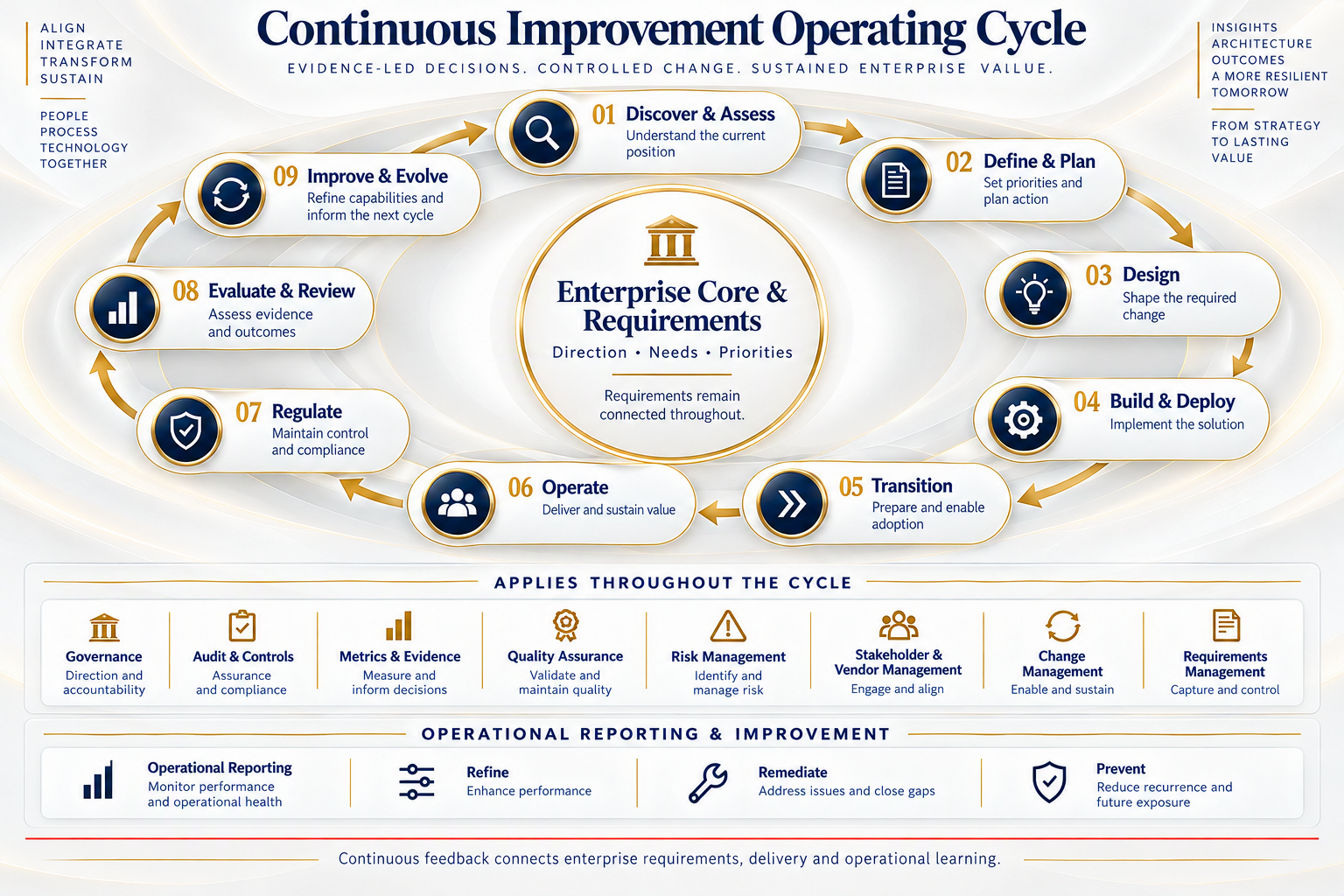
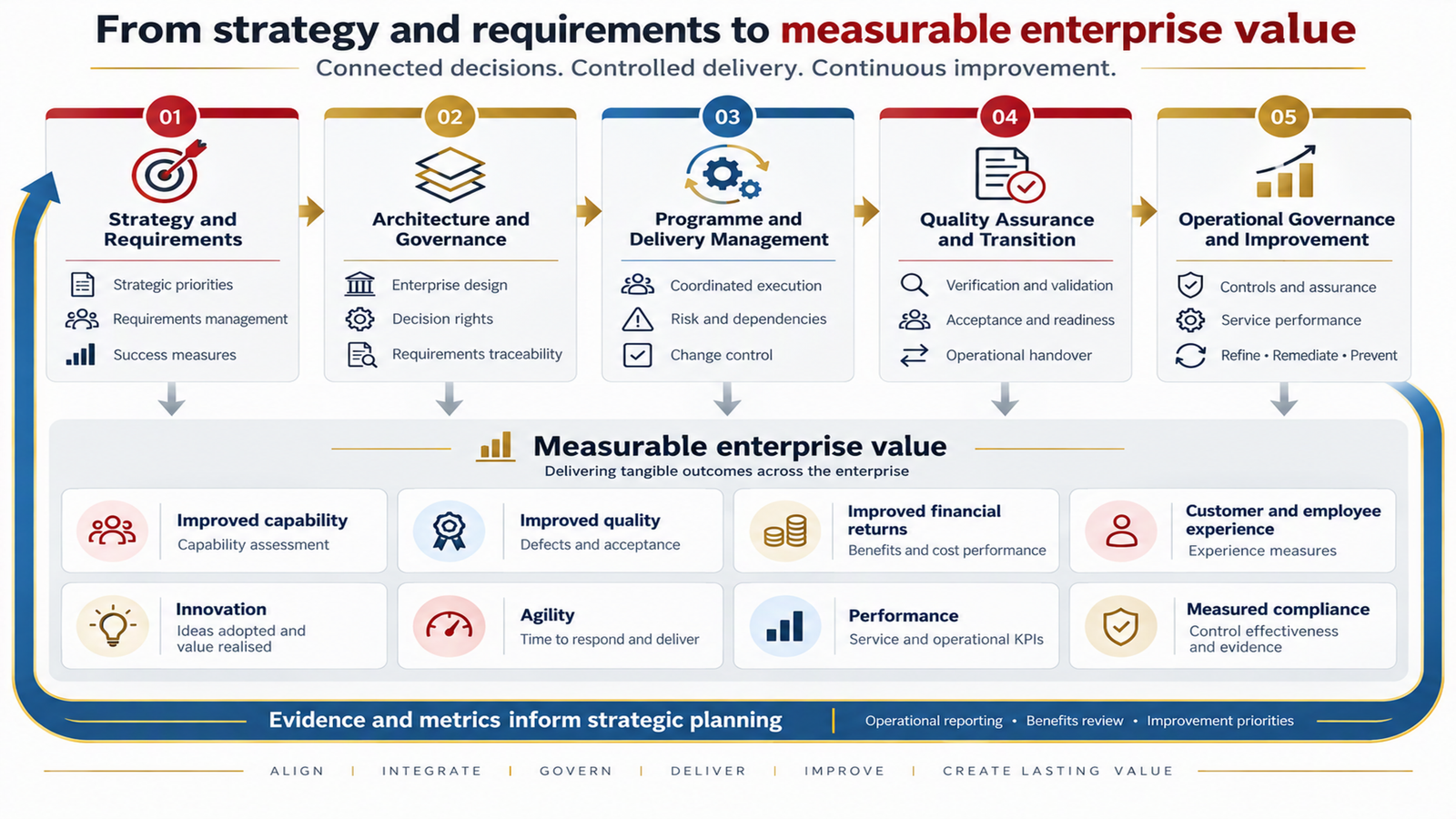
The operating cycle connects Design, Build and Deploy, Transition, Operate, Regulate, Optimise, Improve, and Evaluate and Review. These are connected operating activities rather than mandatory sequential approval gates. Governance, audit, controls, risk, quality assurance, metrics, operational reporting and evidence apply throughout. Findings route into refinement, remediation, prevention, optimisation or improvement and may create or amend governed requirements.
Interoperability with Established Standards and Frameworks
EAOps is designed to interoperate with established enterprise architecture, requirements engineering, business analysis, programme delivery and adaptive delivery practices. It complements TOGAF, ISO/IEC/IEEE 29148, ISO/IEC/IEEE 15288, ISO/IEC/IEEE 12207, the IIBA BABOK Guide, PMI business analysis guidance, and agile frameworks such as SAFe by providing an enterprise operating context in which requirements remain connected from strategic intent through architecture, delivery, operations and measurable outcomes. EAOps does not claim equivalence to, replacement of or certification against those standards.
Practical Interoperability
EAOps can map TOGAF architecture requirements and repository records; ISO/IEC/IEEE stakeholder, system and software requirements information; BABOK requirements and design life-cycle records; PMI requirements traceability and acceptance artefacts; and agile epics, capabilities, features, stories, enablers and acceptance criteria. Customers may retain their established repositories and delivery tools provided stable identifiers, ownership, baselines, traceability, change authority and evidence remain governed.
EAOPS VALUE OUTCOMES
Measurable Enterprise Value
EAOps is intended to improve capability, quality, financial returns, customer and employee experience, innovation, agility, performance and measured compliance. These are governed outcome categories, not unqualified promises. Each engagement establishes relevant measures, evidence sources, baselines and decision thresholds.
INTEROPERABLE CONTEXT
EAOps and ProjPro
ProjPro is the consulting and delivery brand. EAOps is the trademarked Enterprise Architecture Operations framework used to connect enterprise improvement, architecture, programme delivery, governance and operations. ProjPro applies EAOps proportionately, complementing customer methods, repositories, platforms and governance rather than requiring rigid replacement.
Start with the Enterprise Question
EAOps adoption can begin with one material requirement, decision, transformation, operating concern or improvement opportunity. The first step is to establish the enterprise context, evidence, stakeholders, requirements and authority needed to govern the pathway from intent to measurable outcomes.
FREQUENTLY ASKED QUESTIONS
Understanding EAOps
What does EAOps mean?
As ProjPro's proprietary framework, EAOps means Enterprise Architecture Operations.
Does EAOps replace TOGAF or other standards?
No. EAOps provides an operating context that can complement TOGAF, ISO/IEC/IEEE requirements and lifecycle standards, IIBA BABOK, PMI guidance and adaptive delivery frameworks.
Where does Requirements Management sit?
Requirements form part of the Enterprise Core, while Requirements Management applies across every domain, function and lifecycle activity to define, trace and govern requirements and evidence.
What is bidirectional traceability?
Bidirectional traceability connects each requirement backwards to its driver, obligation, outcome and stakeholder need, and forwards to architecture decisions, delivery scope, design, verification, acceptance, release, operational measures and benefits.
How are validation, verification and acceptance different?
Validation confirms the right requirement; verification confirms it was implemented correctly; acceptance is the authorised decision that the evidence and outcome are acceptable.
Must every agile item carry the same controls?
No. EAOps applies controls proportionately while preserving stable identity, ownership, traceability, acceptance and evidence for material requirements.
How does EAOps support continuous improvement?
Operational evidence informs evaluation, optimisation, improvement priorities and updated requirements, which reconnect to architecture and delivery.
Is ProjPro and EAOps trademarked?
Yes. EAOps and ProjPro are trademarks or registered trademarks in Australia and/or other countries.
START THE CONVERSATION
Start with the requirement, decision or outcome that matters.
ProjPro can help establish the evidence, governance and EAOps pathway needed to move forward.
By clicking the button, you agree to our terms and conditions and privacy policy.
This site is protected by reCAPTCHA and the Google privacy policy and terms of service apply.